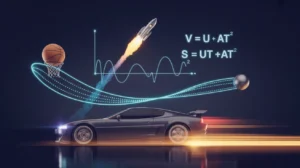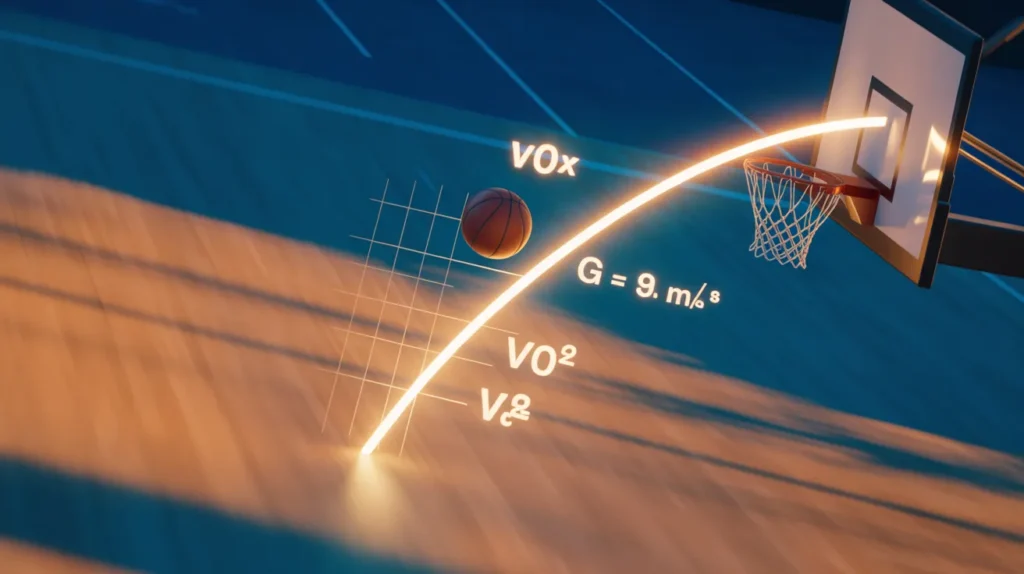
Picture yourself at a neighborhood basketball court. A player takes a jump shot from beyond the three-point line. The ball leaves their hands, rises in a smooth curve, hangs for a moment near the top of its path, then drops perfectly through the hoop. That arc is no accident. It’s a perfect demonstration of projectile motion—the same physics that governs cannonballs, fireworks, fountain streams, and even the early stages of a rocket launch.
Whether you’re a student tackling physics for the first time, a coach refining technique, or simply someone who wants to understand the world more deeply, this guide will give you clarity. We’ll explore the concepts from multiple angles, build strong mental models, and connect the math to real life so the ideas stick with you long after you finish reading.
What Is Projectile Motion?
Projectile motion is the motion of an object that is launched into the air and then moves under the influence of gravity alone, after the initial push ends. Once released, the object becomes a projectile—no engines, no wings, no continuing force in the direction of travel.
In classical mechanics, we usually make two simplifying assumptions: air resistance is negligible, and the acceleration due to gravity (g = 9.8 m/s²) is constant and always points straight down. These assumptions work remarkably well for basketballs, baseballs, and many engineering problems.
Galileo Galilei was among the first to study this seriously. He realized that the motion could be understood by separating it into parts, a breakthrough that helped lay the foundation for modern physics and Newton’s laws of motion.
At its heart, projectile motion shows how a single force—gravity—creates complex, predictable paths from simple rules.
Core Concept: Independence of Horizontal and Vertical Motion
Here is the idea that makes everything simpler: horizontal and vertical motions are independent of each other.
Gravity only pulls vertically. There is no horizontal force (in the ideal case), so the horizontal velocity never changes. The vertical motion, however, is constantly accelerated downward by gravity, just like an object in free fall.
Powerful mental model: Drop one ball straight down from shoulder height while simultaneously throwing another ball horizontally with force. Both balls hit the ground at exactly the same instant. The thrown ball travels farther sideways, but falling time is identical. This counter-intuitive truth is fundamental.
This independence comes directly from Newton’s laws. Forces (and accelerations) add as vectors. Since gravity acts only in the y-direction, it has zero effect on the x-direction.
Setting Up Equations (Step-by-Step Explanation)
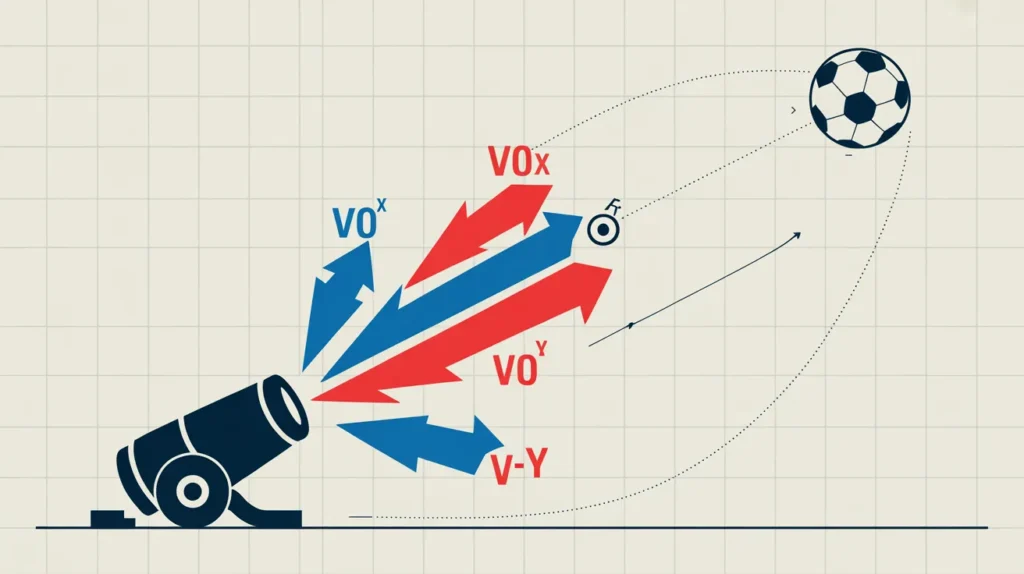
Let’s break an initial velocity v₀ launched at an angle of projection θ (measured from the horizontal) into components:
- Horizontal component: v₀ₓ = v₀ × cosθ
- Vertical component: v₀ᵧ = v₀ × sinθ
Now we can write the position and velocity equations.
Horizontal motion (constant velocity):
x(t) = v₀ₓ × t = (v₀ cosθ) t
vₓ(t) = v₀ₓ (unchanging)
Vertical motion (constant acceleration -g):
y(t) = v₀ᵧ t – (1/2) g t² = (v₀ sinθ) t – (1/2) g t²
vᵧ(t) = v₀ᵧ – g t
These are the core equations of motion for projectile motion. They come from the standard kinematic equations you learned for one-dimensional motion, applied separately to each direction.
Intuition Box: Time (t) is the bridge connecting both directions. Whatever happens vertically determines how long the object stays in the air, which then tells you how far it travels horizontally.
Deep Explanation of Trajectory (Why a Parabola Forms)
When you combine the equations and eliminate time, y becomes a quadratic function of x. That quadratic relationship produces a parabolic trajectory.
Why does this happen physically? Horizontal distance increases linearly with time. Vertical displacement includes a t² term from acceleration. The combination of linear and quadratic creates the elegant curve we see.
The path is symmetric when launch and landing heights are the same. The object rises while slowing vertically, reaches zero vertical velocity at the peak, then falls while speeding up vertically. Throughout, the horizontal speed stays rock-steady.
Edge case insight: If you launch straight up (θ = 90°), the “parabola” degenerates into a straight line up and down. Horizontal range becomes zero, showing how the general equations still hold in special cases.
The Four Key Results (With Intuition)
- Time to Reach Maximum Height
t_up = (v₀ sinθ) / g
At the top, vertical velocity is zero. This is simply the time needed for gravity to cancel the initial upward speed. - Maximum Height (H)
H = (v₀² sin²θ) / (2g)
Intuition: Higher launch angle or faster speed gives much greater height because height depends on the square of the vertical velocity component. - Total Time of Flight (T) (same launch and landing height)
T = (2 v₀ sinθ) / g
The motion is symmetric, so total time is twice the rise time. This explains why steeper angles keep objects airborne longer. - Horizontal Range (R)
R = (v₀² sin(2θ)) / g
Maximum range occurs at 45°, where sin(2θ) reaches its peak value of 1. Angles like 30° and 60° give identical ranges but very different heights and flight times—useful knowledge in sports and ballistics.
Deeper note: These results emerge naturally from the independence principle. Change one component and you can predict exactly how the others respond.
Energy Perspective (Compare with Kinematics)
Kinematics (the position and velocity equations) tells you what happens when. The conservation of energy approach tells you why in terms of stored and moving energy.
Mechanical energy = kinetic energy + potential energy remains constant (ideal case, no air resistance).
Initial kinetic energy: ½ m v₀²
At maximum height: kinetic energy drops to ½ m (v₀ cosθ)² because only horizontal velocity remains, and potential energy rises to m g H.
Setting them equal gives the same maximum height formula. At landing, the object regains its original speed (though direction is mirrored).
Comparison:
- Kinematics excels at finding time, position at specific moments, and trajectory shape.
- Energy shines when heights differ or when you need speeds without calculating time.
- Using both together gives the most powerful understanding.
This connection between force, motion, and energy is a hallmark of classical mechanics.
Worked Example (Step-by-Step)
Problem: A soccer player kicks a ball at 22 m/s at a 35° angle from ground level. Calculate:
a) time of flight
b) maximum height
c) horizontal range
d) velocity just before it hits the ground (magnitude and direction).
(g = 9.8 m/s²)
Solution:
First, components:
v₀ₓ = 22 × cos(35°) ≈ 22 × 0.8192 = 18.02 m/s
v₀ᵧ = 22 × sin(35°) ≈ 22 × 0.5736 = 12.62 m/s
a) Time of flight: T = (2 × 12.62) / 9.8 ≈ 2.58 seconds
b) Maximum height: H = (12.62²) / (2 × 9.8) ≈ 8.13 meters
c) Range: R = 18.02 × 2.58 ≈ 46.5 meters
(Alternatively using range formula: (22² × sin(70°)) / 9.8 ≈ 46.5 m)
d) At landing, vᵧ = -12.62 m/s (same magnitude, opposite direction due to symmetry)
Speed = √(18.02² + 12.62
²) ≈ 22 m/s (original speed)
Impact angle = arctan(12.62/18.02) ≈ 35° below horizontal.
This example shows how all the pieces work together. Always start with components, then choose the right equation for what you need.
Edge case variation: If the ball was kicked from 1.5 m height (player’s foot), you would solve the quadratic y-equation for a non-zero starting height, leading to a slightly longer flight time and range.
Common Mistakes (Expanded and Explained Deeply)
Many students struggle with projectile motion because of subtle misconceptions:
- Believing the velocity is zero at the highest point. Only the vertical component is zero—the ball is still moving horizontally at full speed. This is why a basketball “floats” sideways across the court at the top of its arc.
- Assuming maximum range is always at 45°. This is true only for level ground. On hills or with air resistance, the optimal angle changes.
- Forgetting that time is the connecting variable. You cannot directly relate range to height without considering time.
- Mixing up signs (positive/negative directions). Choose a coordinate system early—usually up positive, right positive—and stay consistent.
- Ignoring real-world air resistance. It shortens range, makes descent steeper than ascent, and affects lighter objects more.
- Thinking heavier objects have different trajectories. Mass cancels out in the equations, so in ideal conditions, a feather and hammer (as demonstrated on the Moon) would follow the same path if given identical initial velocity.
Taking time to draw free-body diagrams and label components prevents most of these errors.
Real-World Applications
Projectile motion appears everywhere:
- Sports: Basketball shooters adjust release angle and speed. Golfers use launch angle and spin (which adds Magnus force beyond basic model). Quarterbacks in American football throw with precise arcs to reach receivers.
- Engineering: Fireworks designers calculate angles for spectacular bursts. Irrigation systems and decorative fountains use optimized nozzles. Civil engineers model jumping distances in safety barriers.
- Military and Ballistics: From ancient catapults (which Galileo studied) to modern artillery. Today’s smart munitions add guidance but still rely on core projectile principles.
- Water Streams: Garden hoses and large fountains follow parabolic paths. The visible stream lets you intuitively adjust angle for distance.
- Biology and Nature: Animals leaping, insects jumping, and even volcanic projectiles follow similar rules.
- Space and Exploration: Rockets initially follow curved paths before powered flight takes over. Understanding these basics helped early space programs.
In advanced applications, engineers layer on air drag, wind, spin, and changing gravity with altitude, but the foundational model remains the starting point.

Concept Summary (Quick Recap for Learners)
- Projectile motion = launched object under gravity only.
- Horizontal velocity constant; vertical accelerated by g.
- Trajectory is parabolic due to independent components.
- Key formulas depend on v₀, θ, and g.
- Maximum range at 45° for level ground.
- Energy and kinematics give complementary views.
- Always resolve into x and y components.
Master these ideas and you’ll develop an intuitive feel for motion that applies far beyond physics class.
Mini FAQ Section
What is the main formula for projectile motion range?
For level ground: R = (v₀² sin(2θ)) / g. Maximum at 45°.
Does launch angle affect time of flight?
Yes. Steeper angles increase vertical velocity component and therefore total flight time.
Why is the trajectory a parabola?
Horizontal distance grows linearly with time while vertical displacement grows with t², creating a quadratic (parabolic) relationship.
How does conservation of energy apply?
Total mechanical energy (kinetic + potential) stays constant, allowing easy calculation of speeds and heights without time.
What happens with different launch and landing heights?
Use the full quadratic equation for vertical position and solve for the positive time root.
Who first understood projectile motion?
Galileo made key breakthroughs by separating horizontal and vertical components.
Projectile motion is more than formulas—it’s a window into how simple physical laws create the graceful arcs we see every day. Keep practicing with real throws, different angles, and your own calculations. The more you engage, the more natural the concepts become.
This understanding connects sports, engineering, history, and nature in one elegant framework. You now have the tools to analyze, predict, and appreciate every projectile you encounter.