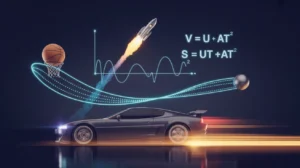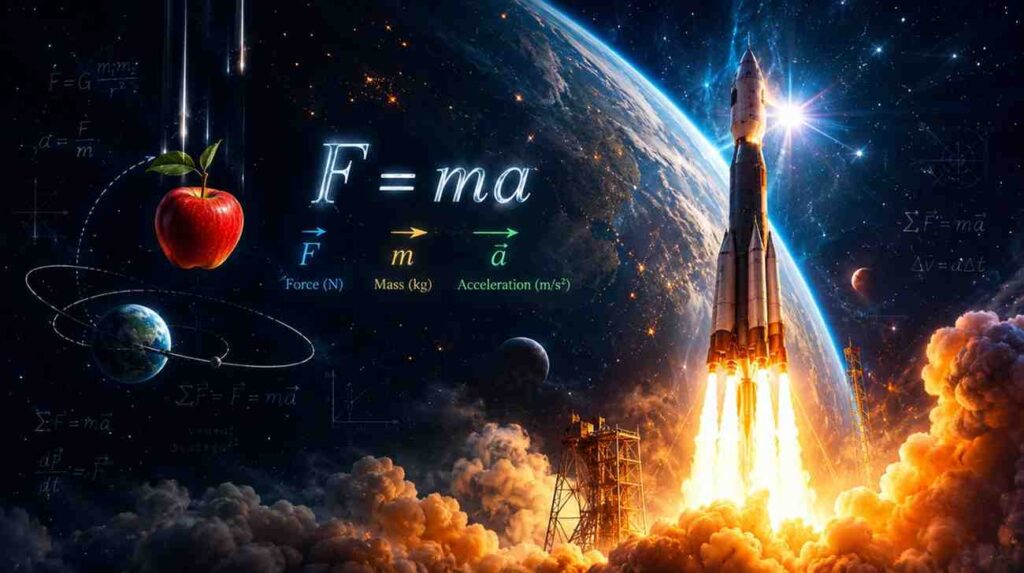
You press the gas pedal, and your car surges forward. A soccer player strikes the ball, sending it curving toward the goal. A rocket climbs away from Earth, accelerating faster as its fuel burns. In every case, something changes the state of motion. That “something” follows a relationship so fundamental that it quietly orchestrates nearly every physical interaction we experience: F = ma.
Newton’s Second Law—force equals mass times acceleration—transcends being a mere equation. It is the dynamic rule that translates cause into effect in the physical world. It explains why things speed up, slow down, or change direction when forces act on them. It bridges the gap between the invisible pushes and pulls of nature and the visible motion we see.
What is F = ma, at its core? Why has it endured for over three centuries as the cornerstone of classical mechanics? In this comprehensive guide, we’ll unpack the law with clarity for beginners while offering fresh conceptual depth for those who already know the basics. We’ll explore its history, hidden subtleties, real engineering power, limitations, and even its broader implications for how we understand change itself.
The Historical Foundations: Building Toward a New Understanding of Motion
For nearly two thousand years, Aristotle’s view dominated: objects move only while a force pushes them, and they naturally come to rest when the push stops. This matched casual observation—a cart slows and stops when you stop pulling.
Galileo Galilei dismantled this idea in the early 1600s. His inclined plane experiments revealed that objects maintain their velocity unless an external force intervenes. He also showed that acceleration due to gravity is independent of mass (in the absence of air resistance). These insights introduced inertia—the resistance of matter to changes in its motion.
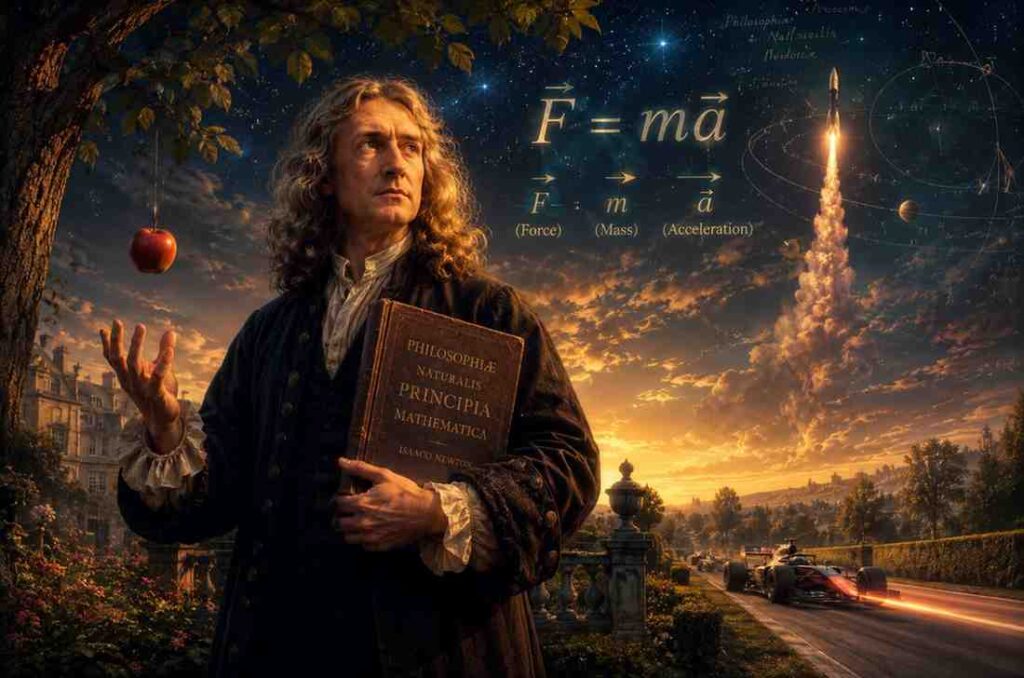
Isaac Newton synthesized and extended this work. During the plague years of 1665–1666, and later in his 1687 masterpiece Philosophiæ Naturalis Principia Mathematica, he formulated three laws of motion. The second law became the quantitative heart of the system.
Newton originally expressed it in terms of momentum: the net force on an object equals the rate of change of its momentum. For systems where mass remains constant, this reduces cleanly to F_net = m a. This form, refined by later mathematicians like Euler, is what most students encounter today. Yet its power lies in its empirical roots—it describes how nature actually behaves, confirmed through observation rather than pure logic.
Newton laws explained a universe that operates by consistent, mathematical rules. The same principles govern a falling apple and planetary orbits, giving humanity its first truly predictive mechanical worldview.
Breaking Down the Equation: What Is F = ma?
F_net = m a
This compact relationship carries precise meaning:
- F_net represents the net (resultant) force—the vector sum of all external forces acting on the object. Individual forces matter only in how they combine.
- m is the inertial mass, quantifying the object’s resistance to acceleration.
- a is acceleration—the rate at which velocity changes in both magnitude and direction.
Because forces and acceleration are vectors, the equation applies independently along each coordinate axis. This decomposition simplifies complex problems, such as separating horizontal and vertical components in projectile motion.
Crucially, F = ma is not a definition. It is an experimental truth about the universe. Newton did not arbitrarily define force as mass times acceleration. He discovered that nature consistently produces acceleration proportional to net force and inversely proportional to mass. This proportionality has been verified across countless experiments and remains one of the most robust statements in physics.
What F = ma Really Reveals: Force Creates Change, Not Steady Motion
The most profound insight—and the one that confuses many—is that a constant net force produces constant acceleration, not constant velocity.
Imagine a spacecraft in deep space with engines firing at steady thrust. Its speed does not level off at some cruising velocity. Instead, it continues accelerating as long as the engines run. On Earth, friction and drag usually mask this, creating the illusion that constant force should produce constant speed. A car traveling at steady highway speed actually experiences zero net force—the engine’s forward thrust perfectly balances air resistance and rolling friction.
This distinction explains the seamless connection between Newton’s First and Second Laws. The first law (objects maintain constant velocity with zero net force) is simply the special case of the second when F_net = 0.
Constant force means velocity changes steadily over time. This principle underlies safety features like airbags, which extend the time of collision to reduce acceleration and thus the force experienced by occupants.
Mental Models to Truly Feel the Law
To internalize Newton’s Second Law, develop intuitive mental models. Think of mass as stubbornness or reluctance to change. A heavy train resists starting and stopping far more than a bicycle. Once moving, that same mass helps it resist small disturbances.
Consider the lurch you feel when a bus brakes suddenly. Your body wants to keep moving forward at the original speed (inertia). The seat or floor applies a backward force that accelerates your body to match the bus’s reduced speed. Your nervous system has unconsciously learned F = ma through years of experience.
Another vivid thought experiment: Stand on a frictionless surface (imagine ice skates on perfect ice). If you throw a heavy ball forward, you accelerate backward. The force you apply to the ball produces an equal and opposite force on you (Third Law), resulting in acceleration inversely proportional to your mass.
These models transform the equation from abstract symbols into something you can sense in daily life.
Why Most People Misunderstand F = ma
Despite its apparent simplicity, Newton’s Second Law harbors several persistent misconceptions.
Many assume a single prominent force (like gravity or thrust) directly determines acceleration. In truth, only the net force matters. An object on a table experiences gravity downward and the normal force upward; they cancel, yielding zero vertical acceleration even though individual forces are large.
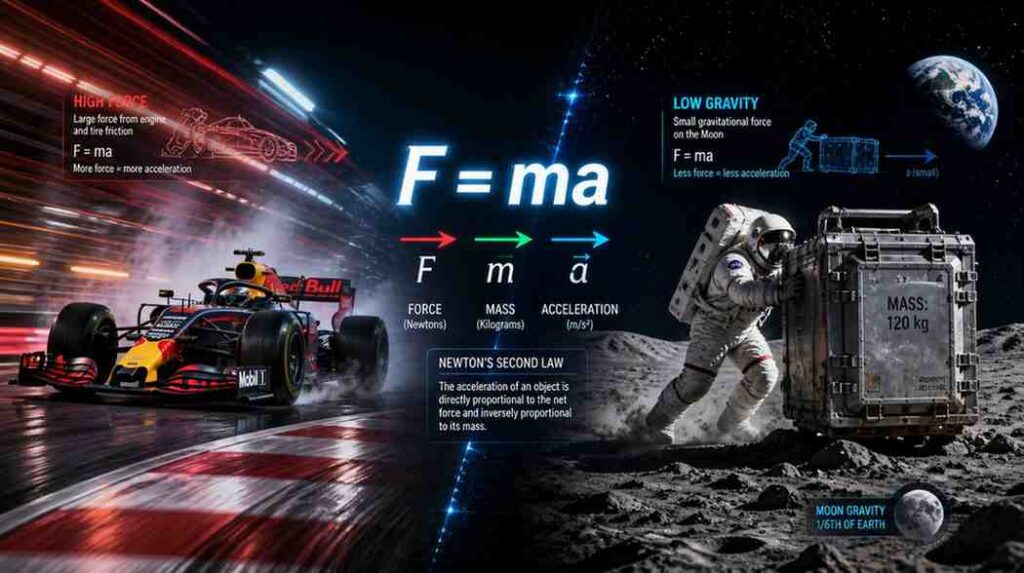
A common confusion equates mass with weight. Mass is an intrinsic property measuring inertia. Weight is the gravitational force (W = mg). Your mass stays the same on the Moon, but your weight drops to roughly one-sixth, making jumps higher and acceleration easier for the same muscular force.
Students often forget that acceleration includes any velocity change—including slowing down or turning. Braking creates a net force opposite to the direction of travel, producing negative acceleration (deceleration).
Textbooks sometimes show idealized single-force scenarios, leading learners to underestimate the careful accounting of all forces required in real analysis.
The Hidden Physics: Inertia, Equivalence, and Subtle Implications
Rearranged as a = F_net / m, the law reveals that greater mass yields smaller acceleration for the same net force. This explains why heavy objects are harder to maneuver yet more stable once moving.
A remarkable fact rarely emphasized in introductory texts is the equivalence of inertial mass and gravitational mass. The property resisting acceleration is identical (to extreme precision) to the property determining gravitational attraction. This equivalence, central to Einstein’s general relativity, explains why a hammer and feather fall together in vacuum. Gravity pulls harder on the hammer, but its greater inertia exactly compensates.
This deep connection hints that gravity may not be a traditional “force” at all, but rather curvature of spacetime—a perspective that becomes essential in advanced physics.
Variable Mass Systems: Rockets and Beyond
The standard F = ma assumes constant mass, but many important systems violate this.
Rockets exemplify variable mass. As they expel exhaust gases backward, their mass decreases while thrust continues. Acceleration increases as mass drops, which is why rockets feel smoother and more powerful later in flight. Engineers use the Tsiolkovsky rocket equation, rooted in momentum conservation, for accurate predictions. The more general form accounts for the relative velocity of expelled mass: F_ext + v_rel (dm/dt) = m (dv/dt).
Similar principles apply to airplanes burning fuel, chains falling from tables, or even biological systems like squirting squid. Understanding variable mass reveals why multistage rockets jettison empty stages—to reduce m and amplify subsequent acceleration.
How Engineers Actually Use This Law in Real Systems
Engineers translate Newton’s Second Law into practical tools daily. They begin with free-body diagrams that isolate every force, sum vector components, and solve for unknown accelerations or forces.
In automotive design, crash analysis focuses on managing deceleration. Extending collision time reduces peak acceleration, lowering injurious forces (F = m a). Aircraft designers ensure thrust and lift produce required accelerations for takeoff and maneuvering. Civil engineers model how wind or seismic forces create accelerations and stresses in massive structures.
Modern applications abound. Finite element analysis software solves millions of simultaneous F = ma equations for complex objects. Smartphone inertial sensors measure acceleration to detect steps, orientation, and crashes. Autonomous vehicles continuously compute net forces and predicted accelerations for safe decision-making. Even biomechanics uses the law to model joint forces and muscle requirements during athletic movements.
The Limits: Where F = ma Breaks Down
Newton’s Second Law dominates at human scales and speeds, but it requires modification at extremes.
In special relativity, as objects approach the speed of light, the simple form fails. Relativistic momentum p = γ m v (with Lorentz factor γ) changes the relationship. A constant force produces progressively smaller acceleration as more energy increases effective inertia.
Quantum mechanics introduces probabilistic behavior at tiny scales. While expectation values often follow classical patterns, individual particles do not follow deterministic F = ma trajectories.
In strong gravitational fields, general relativity describes motion through spacetime curvature rather than traditional forces. Objects follow geodesics and appear to accelerate without a Newtonian force acting.
These boundaries do not invalidate the law—they define its remarkable domain of applicability. Within everyday conditions, it remains astonishingly accurate.
The Deeper Meaning: Force, Causality, and Change
Beyond calculations, F = ma carries philosophical weight. It establishes a clear link between cause (net force) and effect (acceleration). In the absence of net force, motion continues unchanged, elevating constant velocity to the same natural status as rest.
This framework fueled a mechanistic view of the universe during the Enlightenment. It suggests predictability: given initial conditions and forces, motion follows deterministically.
At fundamental levels, “forces” emerge from particle interactions or geometry. Yet the Newtonian description remains the practical language that engineers, athletes, and pilots use instinctively. It mirrors broader patterns of change—sustained effort (force) applied over time produces acceleration toward goals in life as well as physics.
Why This Equation Continues to Run the Universe
From subatomic vibrations to galactic rotations, force mass acceleration relationships shape reality. Newton’s Second Law enables everything from precise satellite orbits to life-saving medical devices, from optimized sports techniques to climate modeling of atmospheric currents.
Its elegance lies in simplicity combined with vast explanatory power. Once you internalize the intuition—net forces drive changes, mass resists, acceleration responds proportionally—the broader structure of classical physics (rotations, fluids, oscillations) flows naturally from this foundation.
Mastering the Law That Governs Motion
Newton’s Second Law (F = ma) offers more than academic knowledge. It provides a lens for seeing the hidden choreography behind everyday motion and cosmic phenomena alike.
The next time you accelerate in traffic, watch a ball arc through the air, or feel yourself pressed back into your seat during takeoff, recognize the same principle at work. Feel the push, sense the resistance, observe the change.
This deceptively simple equation has described motion accurately for 13.8 billion years. It will continue to do so long into the future—quietly, reliably, and universally running the universe.