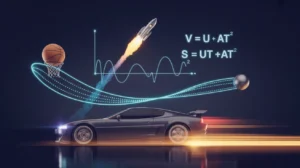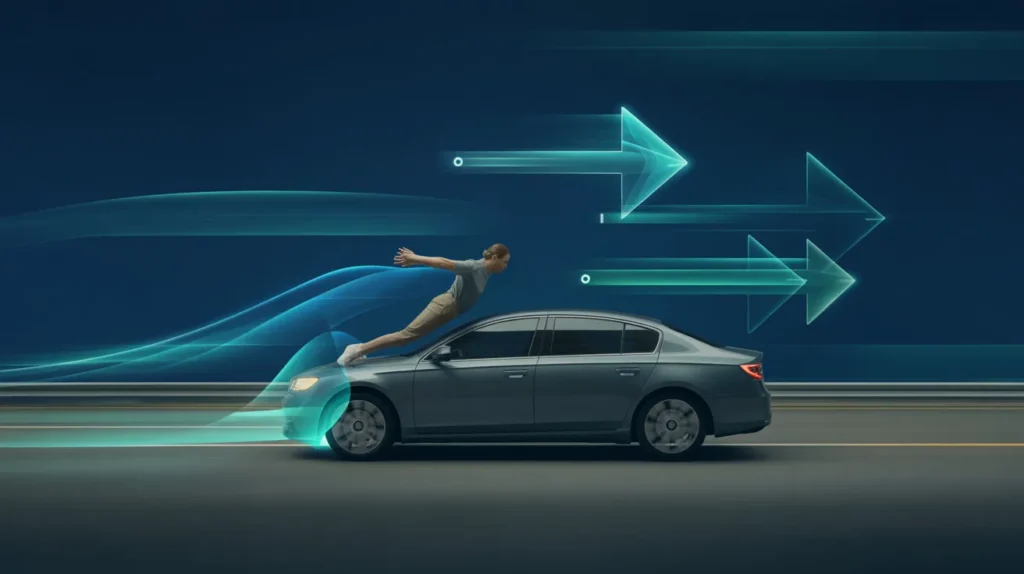
You’re sitting in a moving car. Everything feels normal—steady speed, smooth ride. Suddenly, the driver brakes hard. Your body jerks forward. For a moment, it feels like an invisible force shoved you toward the dashboard. But nothing touched you.
That strange sensation is your body’s way of telling you that your everyday intuition about motion is incomplete. Fixing that misunderstanding is exactly what Newton’s laws of motion do. They don’t just describe how things move—they reveal why motion behaves the way it does, even when it feels “wrong.”
This guide goes far beyond basic definitions. It builds deep, intuitive understanding using real-life examples, mental models, common misconceptions, and connections to broader physics concepts. Whether you’re a student, parent explaining to a child, or lifelong learner, by the end you’ll truly see Newton’s laws everywhere.
Why Newton’s Laws Matter
Isaac Newton published his three laws in 1687 in Philosophiæ Naturalis Principia Mathematica (often called simply the Principia). Standing on the shoulders of Galileo Galilei and others, Newton created a unified framework for classical mechanics—the physics of everyday objects.
These laws explain:
- Why a hockey puck eventually slows on ice but would glide forever in deep space.
- How cars accelerate, rockets launch, and seatbelts save lives.
- The motion of planets, bridges under load, sports equipment, and falling apples.
Newton’s laws of motion remain the practical foundation for most engineering, transportation, sports science, and space exploration. They work with extraordinary accuracy unless you approach the speed of light (relativity) or tiny atomic scales (quantum mechanics).
Mastering them doesn’t just help with exams or problems—it changes how you observe and understand the world.
The BIG IDEA: This Changes Everything
Here is the single most powerful mental model in classical mechanics:
Objects don’t need force to keep moving. Force is only needed to change motion.
Motion is the natural default state.
Stopping, starting, speeding up, slowing down, or changing direction—these all require a net external force.
This insight flips Aristotle’s ancient idea on its head. People once thought continuous force was needed just to maintain motion. Newton showed that in the absence of forces, objects continue with constant velocity (speed and direction).
- Motion is natural.
- Constant velocity requires zero net force.
- Stopping is not natural—it happens because of opposing forces like friction.
Once you internalize this, the three laws stop feeling like separate rules and become different perspectives on the same truth.
Newton’s First Law of Motion: The Law of Inertia
Statement (First Law of Motion):
An object at rest stays at rest, and an object in motion stays in motion with constant velocity (constant speed in a straight line), unless acted upon by a net external force.
This is also called the law of inertia.
What Is Inertia?
Inertia is the tendency of an object to resist any change in its state of motion. It depends only on mass. A heavy truck has far more inertia than a bicycle, making it harder to start, stop, or turn.
Think of inertia as “motion momentum” or built-in “laziness” regarding change. A 10-year-old can understand it this way: heavy things are stubborn about changing what they’re doing.
Real-Life Examples of the First Law
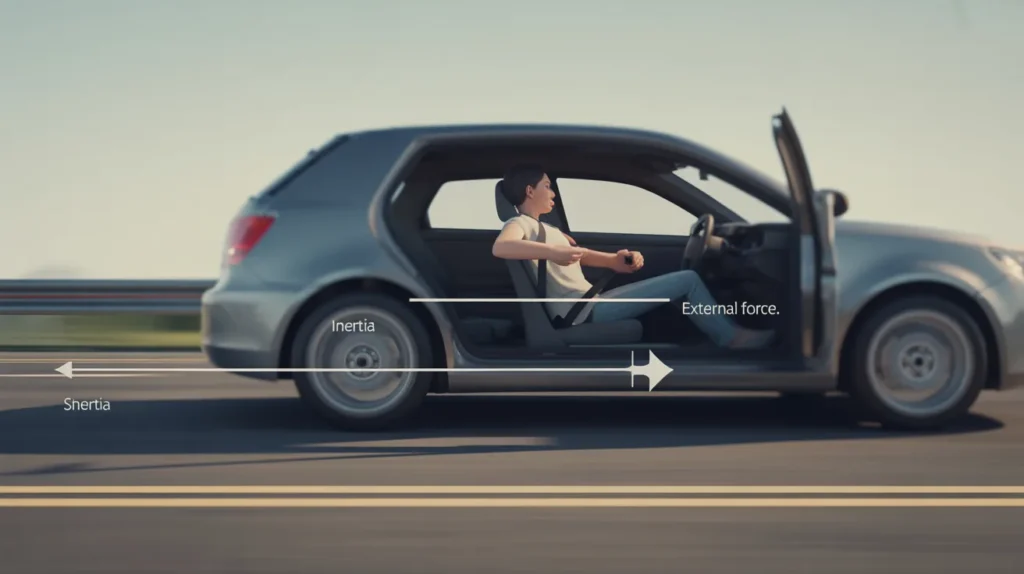
- Seatbelt in a car: When the car brakes, your body wants to keep moving forward at the original speed (inertia). The seatbelt applies the force that changes your motion.
- Hockey puck on ice: On smooth ice with minimal friction, the puck glides in a straight line for a long time. In space, it would never stop.
- Sliding book on a table: Push a book—it slows and stops. Not because motion “wears out,” but because friction provides an unbalanced force opposing the motion.
- Dust in a sunbeam: Tiny particles appear to float because very small forces barely overcome their inertia.
Why objects stop moving: Friction with surfaces and air resistance create a net force opposite to velocity, gradually reducing speed until the object stops. Remove those resistive forces (as in deep space), and motion continues indefinitely.
Common Misconceptions
Many people think objects naturally slow down and stop. The truth is the opposite: objects naturally maintain their velocity. The “stopping” we observe is caused by unseen forces. Galileo’s thought experiments with inclined planes helped Newton see this clearly.
The first law teaches us to always look for the net force. If net force is zero, velocity doesn’t change.
Newton’s Second Law: Force and Acceleration (F = ma)
This is the quantitative heart of the system—the law that lets us calculate exactly what happens.
Second Law of Motion:
The acceleration of an object is directly proportional to the net force acting on it and inversely proportional to its mass.
F_net = m × a (or F = ma)
Intuitive Understanding Before the Formula
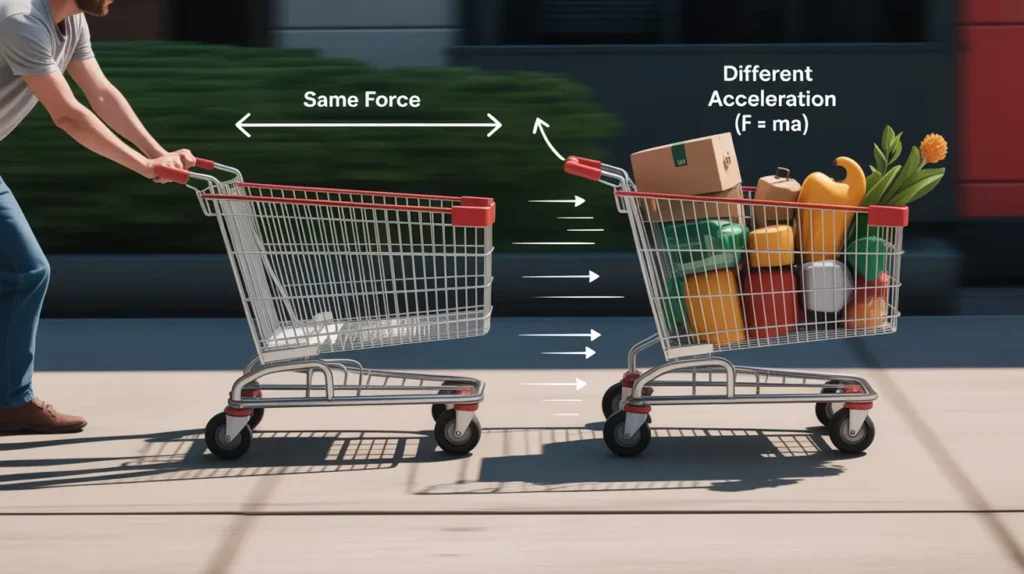
Imagine pushing different objects. A light shopping cart moves easily. Load it with groceries and the same push barely budges it. Kick a light foam ball—it flies away. Kick a heavy soccer ball with the same strength—it moves much less.
Force causes acceleration (change in velocity), not velocity itself.
- More force → more acceleration (same mass).
- More mass → less acceleration (same force).
F = ma meaning in plain language: The net push or pull determines how quickly the object’s speed or direction changes, but heavier objects resist that change more.
Force and Acceleration in Depth
- Force: A vector quantity—a push or pull with both strength and direction.
- Mass: Scalar measure of inertia (kilograms). Doesn’t change with location.
- Acceleration: How quickly velocity changes. It can be speeding up, slowing down, or turning.
A car cruising at constant 100 km/h has high velocity but zero acceleration if speed and direction are steady. Press the accelerator and you create unbalanced force, producing acceleration.
Real-Life Examples of the Second Law
- Empty vs full shopping cart: Same push (force) produces much greater acceleration when empty (less mass).
- Truck vs bicycle: A small force barely accelerates a massive truck but easily speeds up a light bicycle.
- Kicking balls of different masses: Same force, different resulting accelerations.
- Falling objects: Gravity exerts force mg. Acceleration a = F/m = g (about 9.8 m/s²) is the same for all objects in vacuum because mass cancels out. This is why a feather and hammer fall together on the Moon.
Balanced vs Unbalanced Forces
Balanced forces cancel out (net force = 0) → no acceleration. The object stays at rest or moves at constant velocity.
Unbalanced forces mean net force ≠ 0 → acceleration occurs in the direction of the net force.
This distinction explains why a heavy box stays still on the floor (balanced: gravity vs normal force) until you push hard enough to unbalance the horizontal forces.
Units and Dimensional Analysis
The SI unit of force is the Newton (N).
1 N = 1 kg · m/s²
One Newton is the force needed to accelerate a 1 kg mass at 1 m/s². Roughly the weight of a medium apple on Earth.
This unit beautifully shows the relationship: force connects mass with how quickly velocity changes. Dimensional analysis ([M][L][T]⁻²) helps verify equations and builds deeper understanding.
Mass vs Weight: Mass (inertia) stays constant. Weight is the gravitational force (mg) and changes with gravity. On the Moon, your mass is the same but weight is about 1/6th.
Newton’s Third Law: Action-Reaction Pairs
Third Law of Motion:
For every action force, there is an equal and opposite reaction force. Forces always occur in pairs acting on different objects.
Deep Insight
These are interaction pairs. When object A pushes or pulls on object B, object B simultaneously pushes or pulls back on A with equal magnitude but opposite direction.
They do not cancel when analyzing one object’s motion because they act on separate bodies.
Real-Life Examples of the Third Law
- Walking: Your foot pushes the ground backward. The ground pushes your foot forward (friction). Without the reaction, you’d slip.
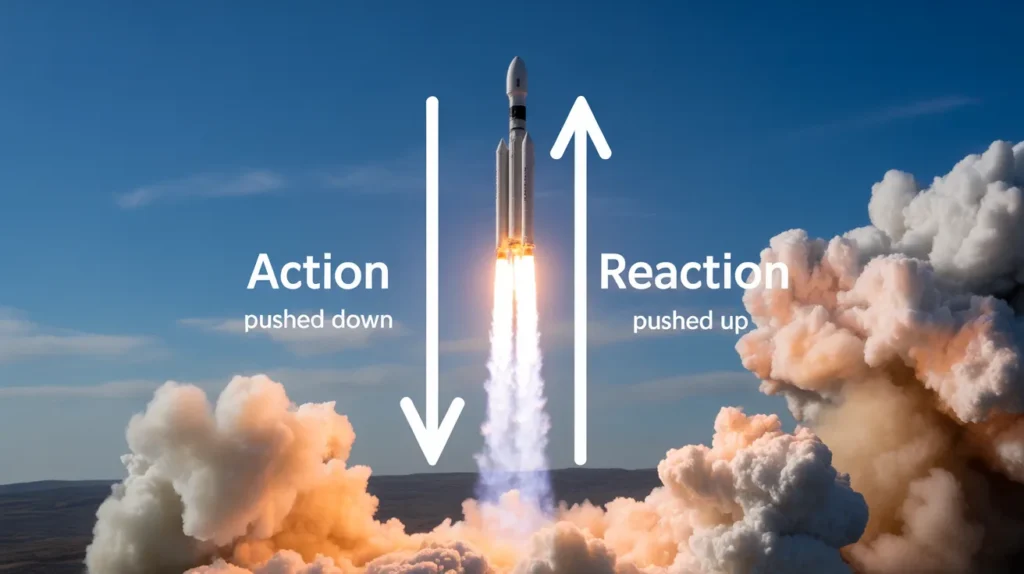
- Rocket launch: The rocket engine pushes hot gases backward at high speed. The gases push the rocket forward. This works in the vacuum of space because the rocket carries its own reaction mass.
- Swimming: Hands push water backward; water pushes the swimmer forward.
- Pushing against a wall: You push the wall; the wall pushes you back. You don’t move if friction with the floor balances the forces.
- Jumping: You push down on the ground; the ground pushes you up.
Common Misconception: “Action and reaction forces cancel, so nothing moves.”
Reality: They act on different objects. The forward push on you (from the ground) and your backward push on the ground affect separate systems.
Free-Body Diagrams: Seeing Invisible Forces
Free-body diagrams (FBDs) are one of the most powerful problem-solving tools in physics. They isolate an object and show all external forces acting on it.
How to Draw a Free-Body Diagram (Step-by-Step)
- Choose the object you’re analyzing.
- Draw a simple dot or box representing the object.
- Draw arrows for every external force acting on it, starting from the center.
- Label each force (weight, normal, friction, applied, tension, etc.).
- Choose coordinates (usually x-y) and resolve forces into components if angled.
- Sum the forces (ΣF) and apply F = ma.
Examples:
- Book on table: Weight down, normal force up—equal and balanced.
- Accelerating car: Forward force from road on tires, backward drag and friction, vertical weight and normal.
- Hanging sign: Tension up, weight down.
FBDs turn complex real-world situations into clear visuals, helping identify the net force accurately.
Hidden Connections: Momentum and Energy
Newton’s laws connect seamlessly to broader concepts.
Momentum (p = m × v): The second law can be expressed as net force equals the rate of change of momentum. In isolated systems (no external net force), total momentum is conserved—explaining collisions, rocket propulsion, and more.
Energy and Work: Net work done on an object equals its change in kinetic energy. Forces over distances transfer energy, linking motion to the work-energy theorem.
These connections show the laws aren’t isolated rules but part of a unified, elegant framework. Understanding them lets you predict and explain phenomena across scales.
FAQs
What are Newton’s laws of motion?
Newton’s laws of motion are three fundamental principles describing inertia (objects resist change), the relationship between force and acceleration (F=ma), and action-reaction pairs. They form the foundation of classical mechanics for everyday motion.
What is the first law of motion (law of inertia)?
An object at rest stays at rest and an object in motion continues at constant velocity unless a net external force acts. Inertia is resistance to change in motion.
What is F = ma meaning?
Net force equals mass times acceleration. More force or less mass produces greater acceleration—force creates change in motion.
Why do objects stop moving?
Objects stop because unbalanced forces like friction and air resistance act against their inertia, causing deceleration. In the absence of such forces, motion continues.
What are real-life examples of Newton’s laws?
Braking car (inertia and seatbelt), pushing a shopping cart (F=ma), walking or rocket propulsion (action-reaction), and free-body analysis of forces on vehicles.
What are Newton’s three laws of motion?
First: Law of inertia. Second: F=ma. Third: Equal and opposite action-reaction forces. Together they explain all classical motion.
Who discovered Newton’s laws?
Isaac Newton, published in Principia Mathematica in 1687, building on Galileo Galilei’s ideas.
Do objects need force to keep moving?
No. Only to change motion (start, stop, or turn). Constant velocity requires zero net force.
Why do heavier objects need more force to accelerate?
Greater mass means greater inertia, so more force is required for the same acceleration (from F=ma).
What is the difference between balanced and unbalanced forces?
Balanced forces cancel (net force=0, no acceleration). Unbalanced forces produce net force and cause acceleration.
How do free-body diagrams help?
They visually isolate all forces on one object, making it easy to calculate net force and apply the second law.
Do Newton’s laws work in space?
Yes—often more clearly, since there’s minimal friction and air resistance.
What is a real-life example where all three laws appear together?
Driving a car: inertia when braking, F=ma when accelerating, action-reaction between tires and road.
Why is friction important in understanding these laws?
Friction often provides the unbalanced force that causes deceleration, creating the illusion that motion naturally stops.
How are Newton’s laws connected to momentum?
The second law relates force to the rate of change of momentum, leading to conservation of momentum in isolated systems.
What is the difference between mass and weight?
Mass measures inertia (constant). Weight is the gravitational force on that mass (changes with gravity).
Can a 10-year-old understand these laws?
Absolutely—using everyday examples like bikes, balls, cars, and playground swings.
Conclusion: Thinking Like Physics
Newton didn’t just explain motion. He gave us a new way to see reality. Motion is natural. Force causes change. Interactions always come in pairs. Friction and other forces explain why the world sometimes seems to contradict these rules.
Once you internalize these ideas, physics stops feeling like memorization and starts feeling obvious. You’ll notice Newton’s laws while riding a bike, throwing a ball, watching a rocket launch, or simply walking across a room.
This understanding builds confidence not just in science class but in observing and appreciating the elegant rules governing our universe. Keep looking for examples in daily life. The more you notice them, the deeper your intuition grows.
Physics isn’t distant or abstract—it’s happening all around you, right now. And thanks to Newton, it finally makes sense.