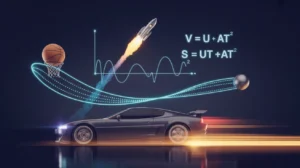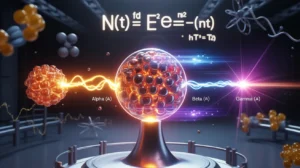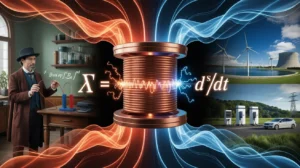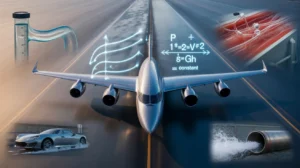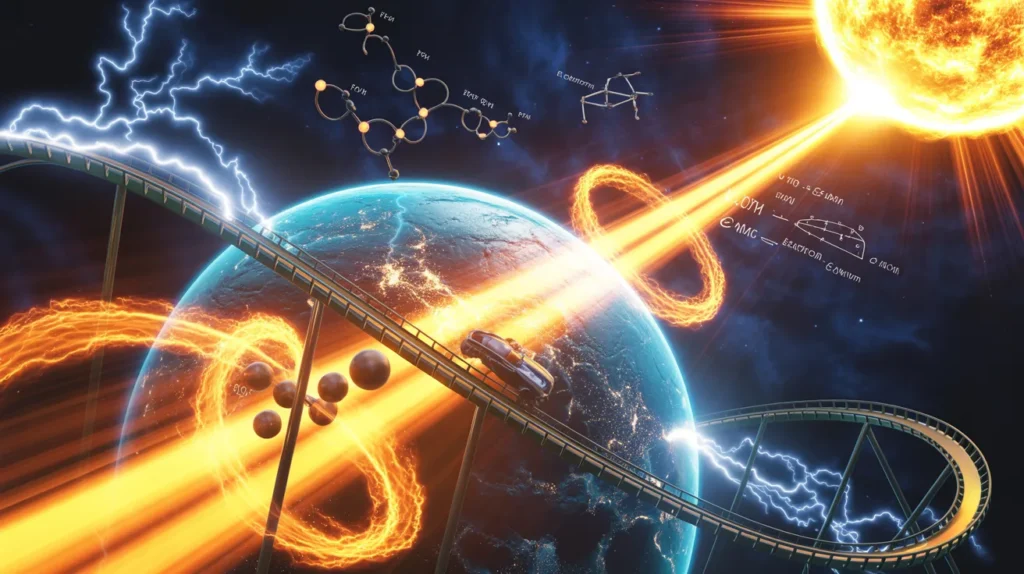
In physics, energy is defined as the quantitative property of a physical system that measures its capacity to do work or transfer heat. It is a scalar quantity, possessing magnitude but no direction, and is measured in joules (J) in the SI unit system.
Energy is not a substance, a material thing, or a force. It is an abstract accounting property of systems. You cannot hold energy in your hand, yet every physical process involves its transfer or transformation. The most precise everyday definition remains: energy is the capacity to do work, where work is the product of force and displacement in the direction of the force.
This definition connects directly to mechanics. When a force acts over a distance, it transfers energy. The system that performs the work loses energy; the system that receives it gains energy. Because energy is a scalar, calculations simplify compared to vector quantities like force or momentum.
Why energy is fundamental: It unifies physics. The same concept applies across mechanics, thermodynamics, electromagnetism, and relativity. Energy’s conservation — its invariance in isolated systems — makes it a powerful predictive tool. Unlike force, which depends on reference frames in some contexts, energy provides a consistent framework for analyzing change.
Energy exists as a property, not a substance. Physicists calculate it for systems based on motion, position, configuration, or other attributes. This abstraction allows energy to appear in many forms while its total quantity in an isolated system remains fixed.
2. Why Energy Is Fundamental in Physics
Energy’s importance stems from its universality, conservation, and predictive power. It connects every branch of physics. Kinetic energy links to motion and mechanics, thermal energy to thermodynamics, electromagnetic energy to light and electricity, and chemical energy to molecular interactions.
The law of conservation of energy states that the total energy of an isolated system remains constant. Energy transforms — from potential to kinetic, chemical to thermal — but is neither created nor destroyed. This law has no known exceptions across all domains of physics.
This conservation arises from a deep symmetry, explained by Noether’s theorem. Emmy Noether showed that every continuous symmetry of the laws of physics corresponds to a conserved quantity. The symmetry of time — the idea that the laws of physics do not change with time — directly implies the conservation of energy. If the laws were different tomorrow than today, energy would not be conserved.
This connection reveals why energy is so powerful: it encodes the uniformity of time in physical law. Energy methods often solve problems more efficiently than force-based approaches, revealing invariants that simplify complex systems.
3. Historical Development of Energy
The modern concept of energy evolved gradually. Aristotle used energeia to describe activity or actuality versus potentiality, an early philosophical distinction.
Galileo studied falling bodies and pendulums, observing that quantities related to motion appeared conserved in ideal conditions. Newton’s laws of motion provided the mathematical framework of forces and acceleration but emphasized momentum more directly.
The quantitative understanding emerged in the 19th century. James Prescott Joule demonstrated the mechanical equivalent of heat through experiments showing that work could be converted into thermal energy predictably. Hermann von Helmholtz and others generalized this into the principle of conservation of energy across all forms.
Michael Faraday’s work on electromagnetism showed connections between electrical, magnetic, and mechanical effects. These developments unified disparate phenomena under one concept.
Albert Einstein’s 1905 special relativity completed the picture with mass-energy equivalence, expressed as E = mc². Mass itself became recognized as a concentrated form of energy, explaining nuclear processes where small mass changes release enormous energy.
4. Units of Energy
The SI unit, the joule (J), equals one newton-meter (N·m) or kg·m²/s². Physically, it represents the energy transferred when a one-newton force moves an object one meter in its direction.
- Calories: One calorie raises the temperature of one gram of water by 1°C (approximately 4.184 J). Dietary Calories (kcal) are 1000 times larger. This unit highlights energy’s role in thermal processes.
- Electron volts (eV): 1.6 × 10⁻¹⁹ J, used in atomic and particle physics. It measures the energy gained by an electron across one volt potential difference. Visible light photons carry a few eV each.
- Kilowatt-hours (kWh): 3.6 × 10⁶ J, common in electricity billing. It quantifies energy as power (rate of transfer) sustained over time.
These units underscore that energy quantifies capacity for change, whether mechanical, thermal, or electrical.
5. Kinetic Energy
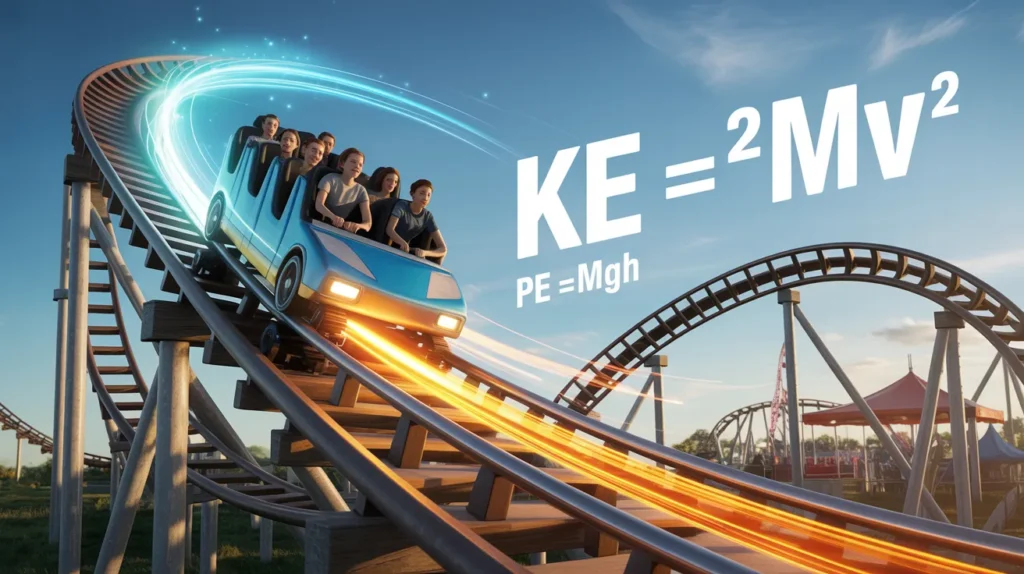
Kinetic energy (KE) is the energy associated with an object’s motion. Its formula is:
[ KE = \frac{1}{2} m v^2 ]
where m is mass and v is speed.
Work-energy theorem: The net work done on an object equals its change in kinetic energy:
[ W_{net} = \Delta KE = \frac{1}{2} m v_f^2 – \frac{1}{2} m v_i^2 ]
This follows from Newton’s second law. Integrating force over distance yields the ½mv² form. The velocity-squared dependence arises because higher speeds mean the force acts over greater distances during acceleration, or equivalently, from the mathematics of integrating v dv.
Intuitively, kinetic energy represents the work required to accelerate an object from rest to speed v. The square term explains why small speed increases at high velocities have dramatic effects, as in collisions. Kinetic energy is always non-negative and zero at rest. It relates to but differs from momentum (mv); energy is scalar and quadratic in velocity.
In collisions, elastic ones conserve kinetic energy; inelastic ones convert some to other forms like thermal energy or deformation.
6. Potential Energy
Potential energy is stored energy due to position or configuration within a conservative force field. Conservative forces allow path-independent work, enabling definition of potential energy.
Gravitational potential energy near Earth’s surface:
[ PE_g = mgh ]
This approximates the work against gravity over height h. It is relative to a chosen reference point.
Elastic potential energy in a spring (Hooke’s law, F = -kx):
[ PE_s = \frac{1}{2} k x^2 ]
The ½ factor again arises from averaging the varying force over distance.
Electric potential energy depends on charge arrangement in electric fields. Chemical potential energy arises from molecular configurations and bond strengths.
Potential energy differences matter physically. Only changes drive processes. In conservative systems, total mechanical energy (KE + PE) remains constant absent non-conservative forces like friction.
7. Mechanical Energy
Mechanical energy is the sum of kinetic and potential energies in a system. In ideal cases with only conservative forces:
[ KE + PE = \text{constant} ]
Examples include pendulums (gravitational PE converts to KE and back), roller coasters (height converts to speed), and free fall (PE fully converts to KE, yielding ( v = \sqrt{2gh} )).
Friction introduces non-conservative work, dissipating mechanical energy into thermal energy. The total energy, including thermal, remains conserved. Energy methods simplify analysis because mass often cancels and path details become unnecessary.
8. Conservation of Energy
The law of conservation of energy is physics’ most robust principle: in an isolated system, total energy is constant. Energy transforms but is not destroyed.
In real systems, mechanical energy often decreases due to friction, but this “lost” energy appears as thermal energy — increased random molecular motion. The first law of thermodynamics formalizes this: ΔU = Q – W (change in internal energy equals heat added minus work done).
Entropy (second law) explains why transformations are irreversible in practice. Usable energy disperses into disordered thermal energy, increasing entropy. This prohibits perpetual motion machines of the first kind (creating energy) or second kind (converting heat fully to work without losses).
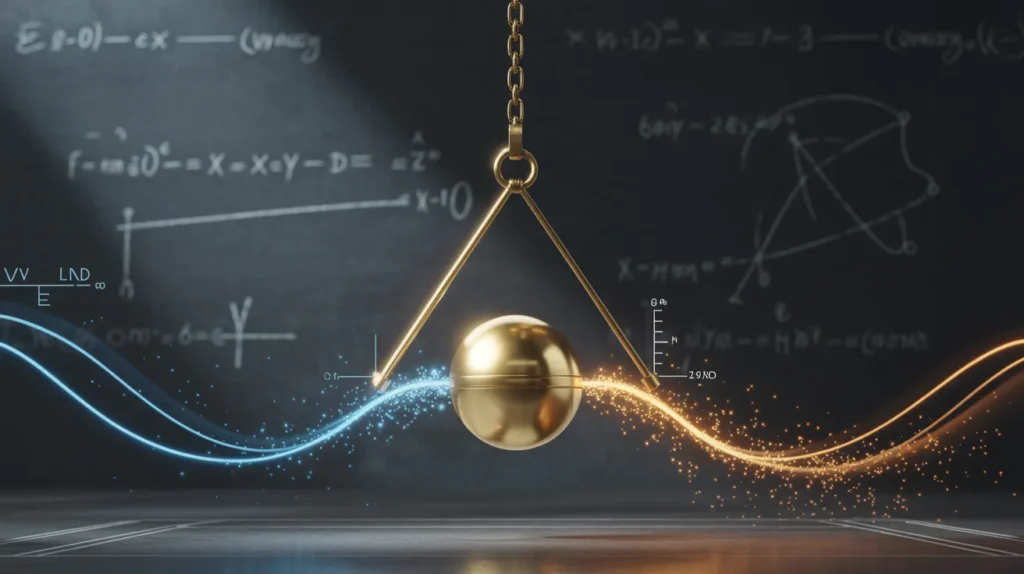
The pendulum illustrates this perfectly. At maximum height, PE is maximum and KE zero. At the bottom, KE peaks. Friction gradually converts mechanical energy to heat in the pivot and air, yet total energy (mechanical + thermal) stays constant.
9. Forms of Energy
- Mechanical energy: Sum of KE and PE.
- Thermal energy: Microscopic kinetic energy of random particle motion, related to temperature but including potential from intermolecular forces.
- Electrical energy: Associated with charge separation or flow in electric fields.
- Chemical energy: Stored in molecular bonds; released or absorbed in reactions via rearrangements of electron configurations.
- Nuclear energy: Binding energy within atomic nuclei, explained by mass-energy equivalence.
- Radiant/electromagnetic energy: Carried by electromagnetic waves or photons (E = hf for photons in quantum mechanics).
- Sound energy: Mechanical vibrations propagating as pressure waves in a medium.
At the fundamental level, most forms reduce to kinetic and potential at microscopic scales, unified through quantum and relativistic descriptions.
10. Energy Transformations
All physical processes involve energy transformation. A car engine converts chemical energy (fuel bonds) to thermal energy (combustion), then to mechanical energy (pistons), and finally kinetic energy. Each step incurs entropy losses, limiting efficiency.
Efficiency measures useful output over input. Thermodynamic limits (Carnot efficiency) arise from entropy. Photosynthesis transforms radiant energy into chemical energy. Hydroelectric plants convert gravitational PE into electrical energy.
These chains highlight conservation: total energy input equals output plus dissipated heat.
11. Energy in Modern Physics
Einstein’s E = mc² reveals mass-energy equivalence. Rest energy is mc²; total energy in relativity includes kinetic contributions. Nuclear fission and fusion release energy because product nuclei have slightly less mass than reactants.
In quantum mechanics, energy is quantized. Electrons occupy discrete energy levels in atoms; photons carry discrete quanta (E = hf). The Heisenberg uncertainty principle allows temporary energy “borrowing” for virtual particles.
Vacuum energy arises from quantum field fluctuations. Dark energy drives cosmic acceleration, representing energy density of space itself.
12. Energy vs Power
Energy is the total capacity; power is the rate of energy transfer or conversion (power = energy/time, SI unit watt = J/s). A battery stores energy (kWh); a bulb’s wattage indicates power consumption rate.
13. Real-World Applications
Engineers optimize transformations for higher efficiency in engines and renewables. Electronics manage thermal dissipation. Medicine uses targeted radiation (nuclear/electromagnetic) and MRI (magnetic energy). Transportation shifts to electric systems for better efficiency. Space exploration relies on solar (radiant to electrical) and nuclear power sources.
14. Common Misconceptions
- Energy is not “used up” — it transforms, often into less usable thermal forms.
- Energy is not a force; forces mediate energy transfers.
- Cold is not a substance or negative energy; it represents lower thermal energy.
- Perpetual motion violates conservation or entropy principles.
- Energy exists in rest mass (E=mc²), even in “stationary” objects.
15. FAQs
What is the definition of energy in physics?
Energy is a scalar quantity representing the capacity to do work or produce heat, conserved in isolated systems.
What are the main types of energy in physics?
Mechanical (kinetic + potential), thermal, electrical, chemical, nuclear, radiant/electromagnetic, and sound.
What is the law of conservation of energy?
The total energy in an isolated system remains constant; energy transforms but is neither created nor destroyed.
Why is kinetic energy proportional to velocity squared?
It follows from the work-energy theorem; work integrates to yield the ½mv² form due to the relationship between velocity and distance under acceleration.
How does E=mc² fit into energy concepts?
It shows mass is a form of energy, explaining nuclear energy release through mass defects.
What is the difference between energy and power?
Energy is total amount; power is the rate at which energy is transferred or converted.
How is energy related to entropy?
Conservation (1st law) preserves quantity; entropy (2nd law) governs quality and direction of transformations toward disorder.
16. Conclusion
Energy stands as physics’ central unifying concept. From Noether’s symmetry linking time invariance to conservation, through the work-energy theorem, to mass-energy equivalence, it provides a framework for understanding change across all scales. Mastery of energy principles reveals not just how systems evolve, but the deep symmetries governing reality itself.
Key Takeaways
- Energy is a conserved scalar property measuring capacity for work.
- The work-energy theorem and potential energy definitions enable powerful analysis.
- Conservation connects to time symmetry via Noether’s theorem.
- All processes involve transformations with entropy constraints on efficiency.
- Modern physics unifies energy with mass and quantum phenomena.
This explanation draws from foundational principles across classical and modern physics, offering conceptual depth accessible to learners while remaining rigorous.