
Imagine shaking one end of a long rope. A ripple races away from your hand, yet every small segment of the rope only moves up and down. The disturbance travels horizontally, but the motion is vertical. That perpendicular dance between oscillation and travel direction lies at the heart of one of physics’ most elegant and consequential phenomena: transverse waves.
From the light entering your eyes right now to the seismic waves that reveal Earth’s hidden structure, from guitar strings shaping music to fiber-optic cables powering the internet, transverse waves underpin vast swathes of our physical reality. This comprehensive resource explores every facet — from simple intuitive explanations to advanced quantum connections — delivering the depth, clarity, and authority serious students and curious minds deserve.
What Is a Transverse Wave?
A transverse wave is a wave in which the direction of oscillation (the back-and-forth or up-and-down movement of particles or fields) is perpendicular to the direction of wave propagation (the direction in which energy travels).
This perpendicular relationship — oscillation perpendicular to propagation — defines the entire behavior, capabilities, and limitations of these waves.
Simple Definition of a Transverse Wave
What is a transverse wave?
Think of it like this: the wave travels forward, but the medium (or field) vibrates sideways. It’s the difference between a crowd doing the “wave” in a stadium (people move up and down while the wave pattern travels around) and a line of people passing a message hand-to-hand in the same direction the message travels.
Scientific Definition of a Transverse Wave
In physics, a transverse wave is defined as a wave where the displacement of the medium (in mechanical cases) or the oscillating fields (in electromagnetic cases) occurs at right angles to the direction of energy propagation. Mathematically, if propagation is along the x-axis, displacement occurs in the y- or z-direction (or both).
This definition distinguishes transverse mechanical waves (requiring a medium capable of shear) from electromagnetic transverse waves (self-propagating through vacuum via coupled electric and magnetic fields).
Detailed Labeled Diagram Explanation
Visualize a classic sinusoidal transverse wave traveling left to right:
Direction of propagation →
          Crest
           ▲
           |
Equilibrium ──────────────────────────────
           |
           ▼
         Trough
Richly labeled transverse wave diagram description:
- A smooth sine curve extends horizontally.
- Vertical arrows at peaks point upward, labeled Crest (maximum positive displacement).
- Vertical arrows at valleys point downward, labeled Trough (maximum negative displacement).
- Horizontal double-headed arrow between two consecutive crests is labeled Wavelength (λ).
- Vertical double-headed arrow from equilibrium to crest is labeled Amplitude (A).
- Horizontal arrow along the bottom indicates Wave propagation direction.
- Small vertical double arrows along the curve show Transverse oscillation (perpendicular to propagation).
This diagram makes the perpendicular nature immediately obvious and is the foundation for understanding parts of a transverse wave.
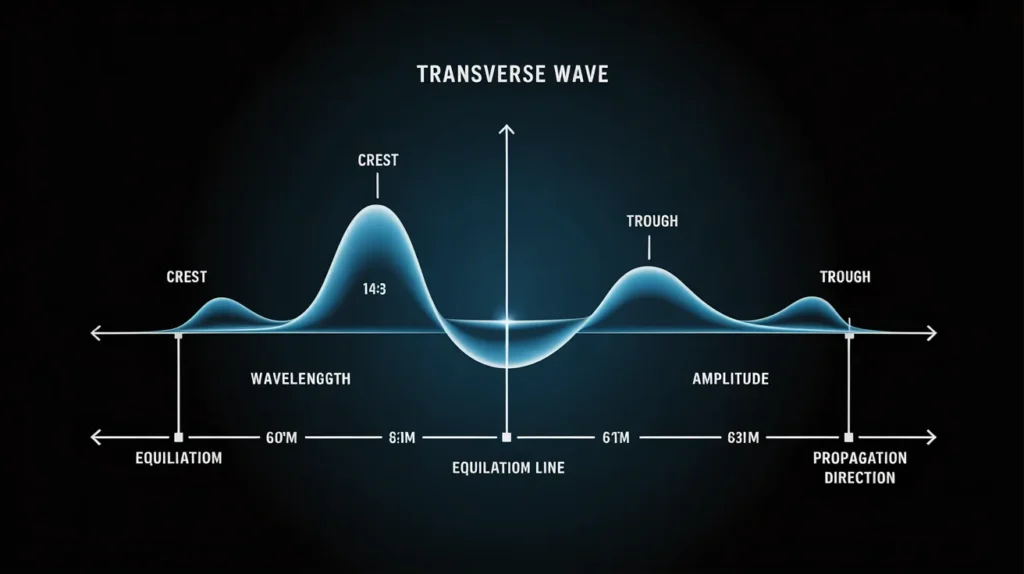
Parts of a Transverse Wave
- Crest and Trough: Points of maximum displacement above and below equilibrium.
- Amplitude (A): Maximum displacement from equilibrium position; determines intensity and energy.
- Wavelength (λ): Distance between consecutive crests or troughs; measures spatial repeat.
- Equilibrium position: Rest position of the medium (undisturbed line).
- Node (in standing waves): Point of zero displacement.
- Antinode: Point of maximum displacement.
Core Properties of Transverse Waves
Transverse wave properties and characteristics include:
- Perpendicular oscillation
- Ability to be polarized (unique among wave types)
- Transfer of energy without net matter transport
- Support for interference and standing waves
- Dependence on medium properties for mechanical waves (shear modulus, tension)
Mathematical Description of Transverse Waves
The displacement of a point on a sinusoidal transverse wave is given by the transverse wave equation:
$$ y(x,t) = A \sin(kx – \omega t + \phi) $$
Where:
- ( y(x,t) ): Displacement at position ( x ) and time ( t )
- ( A ): Amplitude
- ( k = \frac{2\pi}{\lambda} ): Wave number
- ( \omega = 2\pi f ): Angular frequency
- ( \phi ): Phase constant
This equation elegantly captures how the wave pattern evolves while individual particles perform simple harmonic motion (SHM) perpendicular to travel. The restoring force in mechanical cases follows Hooke’s law for small amplitudes, linking directly to Newton’s second law.
Wave Speed Formula and Relationships
The fundamental relationship for all waves is:
$$ v = f \lambda $$
Variables: ( v ) = wave speed, ( f ) = frequency, ( \lambda ) = wavelength.
Physical meaning: The speed at which the wave pattern propagates equals the product of how frequently oscillations occur and the distance between them. Frequency is source-determined; speed is medium-determined; wavelength adjusts accordingly.
For waves on a string (transverse mechanical wave):
$$ v = \sqrt{\frac{T}{\mu}} $$
Derivation intuition: Tension ( T ) provides restoring force; linear density ( \mu ) provides inertia. Balancing via Newton’s laws yields this speed. Higher tension → faster wave. Higher mass density → slower wave.
Period-frequency relation:
$$ T = \frac{1}{f} $$
Energy in transverse waves: Total energy (and intensity) is proportional to the square of amplitude:
$$ \text{Energy} \propto A^2 $$
Doubling amplitude quadruples energy — a direct consequence of SHM energy being ( \frac{1}{2}kA^2 ).
Energy Transfer in Transverse Waves
Waves transport energy and information, not matter. In a transverse wave, particles oscillate about equilibrium. At crests/troughs, velocity is zero (all potential energy via restoring force). At equilibrium, velocity is maximum (all kinetic). This continuous exchange propagates the disturbance.
Mechanical Transverse Waves
Waves on a string are the textbook example. Plucking a guitar string creates a transverse pulse or standing wave. Water waves transverse surface motion is approximately transverse for small amplitudes (particles trace ellipses). Seismic S waves (shear waves) are transverse and cannot propagate through liquids because fluids lack shear rigidity — a fact that revealed Earth’s liquid outer core.
Electromagnetic Transverse Waves
Electromagnetic waves are transverse. They consist of an oscillating electric field perpendicular to an oscillating magnetic field, both perpendicular to the propagation direction. Generated by accelerating charges, they require no medium and travel at ( c \approx 3 \times 10^8 ) m/s in vacuum.
The entire electromagnetic spectrum — radio waves, microwaves, infrared radiation, visible light, ultraviolet radiation, X-rays, gamma rays — comprises electromagnetic transverse waves differing only in frequency and wavelength.
Why Light Is a Transverse Wave
Are light waves transverse? Yes. James Clerk Maxwell’s equations predict self-sustaining perpendicular E and B fields. Experimental confirmation comes from polarization: light can be polarized, which is impossible for longitudinal waves.
Polarization and Its Importance
Polarization of transverse waves restricts oscillation to one plane. Transverse wave can be polarized; longitudinal waves cannot. Polarization filters, Brewster’s angle, and Malus’s law all stem from this property.
Applications include glare-reducing sunglasses, LCD screens, 3D cinema, stress analysis in materials (photoelasticity), and quantum cryptography (photon polarization states).
Interference and Superposition
Transverse waves obey the superposition principle: when waves overlap, total displacement is the algebraic sum. Constructive interference (in phase) increases amplitude; destructive interference (out of phase) cancels it. This produces interference patterns in Young’s double-slit experiment, thin films, and holography.
Standing Waves, Nodes and Antinodes
When a transverse wave reflects and interferes with itself (fixed ends), standing transverse waves form. Points of zero displacement are nodes; maximum displacement are antinodes. The wave appears stationary but energy oscillates between kinetic and potential.

Harmonics and Resonance
Standing waves on strings or in air columns (though the latter often involve longitudinal components) produce harmonics at integer multiples of the fundamental frequency. Resonance occurs when driving frequency matches a natural frequency, dramatically increasing amplitude — the basis of musical instruments and many engineering designs.
Real-Life Examples of Transverse Waves
- Guitar and violin strings (standing waves)
- Ripples on pond surfaces (water waves transverse)
- Seismic S-waves during earthquakes
- Stadium “Mexican wave”
- All forms of light and electromagnetic radiation
Transverse waves examples in real life are ubiquitous once you learn to recognize the perpendicular signature.
Modern Technology Applications
Transverse wave physics powers lasers, microwave ovens, radar, medical ultrasound (though imaging often mixes wave types), and wireless communication.
Fiber Optics and Telecommunications
In fiber optics, light (transverse electromagnetic wave) travels via total internal reflection. Polarization-maintaining fibers control polarization states for high-speed data and sensors. Laser communication systems exploit coherence and polarization of transverse light waves.
Seismic S-Waves and Earthquakes
Seismologists use the absence of S-waves in certain shadow zones to map Earth’s interior. Seismic wave physics relying on transverse vs longitudinal behavior provides our best non-invasive view of the planet’s core.
Transverse Waves in Quantum Physics
At the quantum level, the photon — quantum of the electromagnetic field — exhibits wave-particle duality. Photon polarization (two perpendicular states) is central to quantum information science, entanglement experiments, and interpretations of wave function collapse.
Difference Between Transverse and Longitudinal Waves
The core distinction: transverse vs longitudinal waves lies in oscillation direction relative to propagation.
Detailed Comparison Table:
| Feature | Transverse Waves | Longitudinal Waves |
|---|---|---|
| Oscillation vs Propagation | Perpendicular | Parallel |
| Can be Polarized? | Yes | No |
| Travel in Vacuum? | Yes (EM waves) | No |
| Wave Features | Crests & troughs | Compressions & rarefactions |
| Mechanical Medium Requirement | Shear strength (solids) | Any medium (solid, liquid, gas) |
| Examples | Light, string waves, S-waves | Sound, P-waves |
| Energy Transport | Perpendicular oscillation | Parallel pressure variations |
Is sound a transverse wave? No. Sound is longitudinal. Electromagnetic waves are transverse.
Worked Numerical Examples
Example 1 (v = fλ): A transverse wave on a rope has frequency 12 Hz and wavelength 0.75 m. Calculate speed.
[ v = 12 \times 0.75 = 9 \, \text{m/s} ]
Example 2 (String speed): Tension = 100 N, μ = 0.002 kg/m.
[ v = \sqrt{100 / 0.002} = \sqrt{50000} \approx 223.6 \, \text{m/s} ]
Example 3 (Energy): Amplitude increases by factor of 3. Energy increases by factor of 9.
Advanced Conceptual Examples
Consider a polarized laser beam in fiber optics: controlling polarization minimizes signal loss and enables multiplexing. Or analyze how S-wave attenuation reveals partial melt zones in Earth’s mantle.
Practice Questions
- Draw a labeled transverse wave diagram and mark amplitude and wavelength.
- Explain why only transverse waves exhibit polarization, with physics reasoning.
- A wave has period 0.05 s. Find frequency and speed if λ = 2.4 m.
- Compare propagation of transverse and longitudinal seismic waves through Earth’s layers.
Common Student Mistakes
- Confusing amplitude with wavelength
- Thinking all water waves are purely transverse (they have orbital motion)
- Assuming all EM waves need a medium (historical luminiferous ether mistake)
- Forgetting energy ∝ A² relationship
Exam Tips for GCSE/A-Level Physics (and Class 11)
- Always draw clear, labeled diagrams with arrows for propagation and oscillation.
- Memorize and understand derivations of ( v = \sqrt{T/\mu} ).
- Use polarization as definitive evidence for transverse nature of light.
- Practice superposition sketches for constructive/destructive cases.
FAQ Section (People Also Ask )
What is a transverse wave easy definition?
A wave where the medium vibrates perpendicular to the direction the wave travels.
What are examples of transverse waves?
Light and all electromagnetic waves, waves on a string, ripples on water, seismic S-waves.
Can transverse waves travel through a vacuum?
Yes — electromagnetic transverse waves (light, radio waves, etc.) propagate freely in vacuum.
Why can transverse waves be polarized?
Because oscillation occurs in a plane perpendicular to propagation, allowing restriction to a single direction. Longitudinal waves have only one possible oscillation axis.
What is the transverse wave equation?
( y(x,t) = A \sin(kx – \omega t) ), describing perpendicular displacement.
What is the difference between transverse and longitudinal waves?
Direction of oscillation relative to propagation (perpendicular vs parallel), plus polarization and vacuum propagation capabilities.
Final Scientific Conclusion
Transverse waves represent far more than a textbook category. They embody the deep unity of physics — connecting Newton’s laws and Hooke’s restoring forces in mechanical systems to Maxwell’s unified electromagnetism, and onward to quantum field theory and photon polarization.
Understanding transverse waves physics grants insight into wave mechanics, energy transport, optics, seismology, acoustics (by contrast), and modern technology. The perpendicular oscillation that defines them has shaped our music, our vision, our communication, and our knowledge of Earth and the cosmos.
Whether you are preparing for examinations or pursuing lifelong scientific curiosity, the concepts explored here form a cornerstone of physical literacy. The universe speaks in waves — and a great many of its most illuminating messages arrive via transverse waves.
This resource is grounded in established physics principles (Maxwell, Huygens, Fresnel, and modern quantum electrodynamics) and is regularly updated with educational best practices.