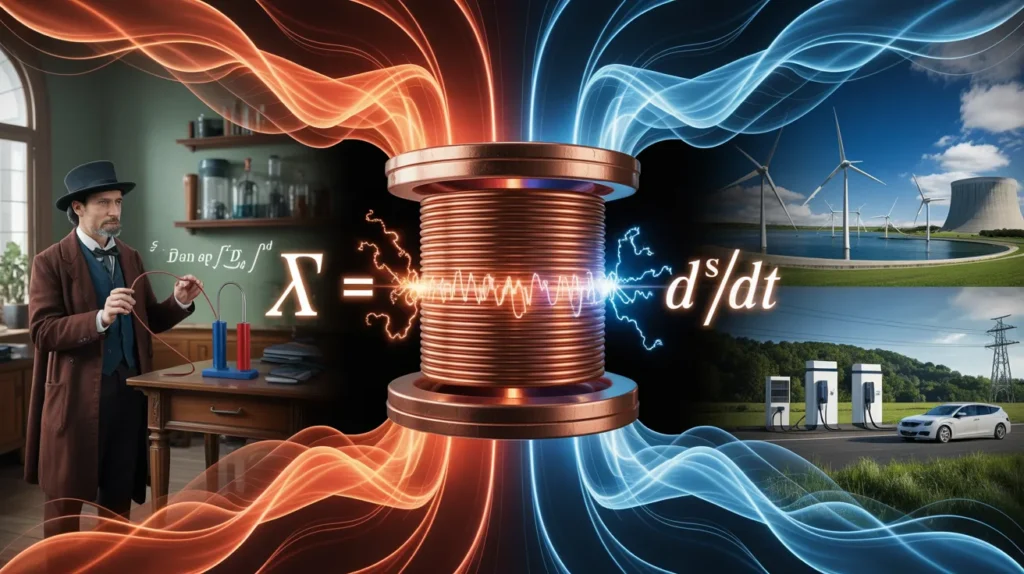
Flip a switch, and your lights turn on. Plug in your phone, and it charges. Drive an electric vehicle, and you glide silently down the road. Behind these everyday miracles stands one of the most transformative discoveries in human history: electromagnetic induction.
Imagine a world without reliable electricity—no power grids, no smartphones, no renewable energy farms, no electric motors powering factories or EVs. Michael Faraday’s 1831 insight that a changing magnetic field can induce an electric current literally electrified civilization. It unlocked the ability to convert mechanical energy into electrical energy on a massive scale and to move that electricity efficiently across continents.
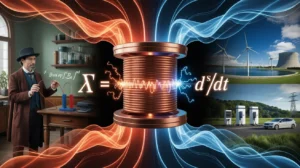
Today, electromagnetic induction powers everything from the massive alternators in hydroelectric dams and nuclear plants to the wireless charging pad on your nightstand, the pickups in an electric guitar, and the induction cooktops in modern kitchens. It is the foundation of Faraday’s law, the working principle of generators, transformers, and countless devices that shape our electrified world.
This article explores the phenomenon deeply—starting from intuitive concepts and building to the physics that engineers rely on daily—while remaining accessible whether you’re a student, enthusiast, or practicing professional.
What is Electromagnetic Induction?
Electromagnetic induction is the production of an electromotive force (EMF, or voltage) across an electrical conductor in a changing magnetic field. That induced EMF can drive a current if the circuit is closed.
The key word is changing. A static magnetic field, no matter how strong, produces no induction. What matters is magnetic flux—the effective number of magnetic field lines passing through a loop or surface—and how that flux varies over time.
Think of it like this: Magnetic field lines are like arrows representing the field’s strength and direction. When those arrows through your loop increase, decrease, or effectively tilt due to motion or rotation, they “cut” across the wire, jostling charges and creating a potential difference.
Motion alone isn’t enough. A wire sitting still in a uniform magnetic field generates nothing. Slide it perpendicular to the field (or rotate a coil), and you get induction because the area or angle changes the flux. Move a magnet toward a stationary coil, and the strengthening field through the coil does the same. This is why generators need continuous change—usually via rotation driven by turbines.
Faraday’s Law of Electromagnetic Induction
Faraday’s law quantifies the effect. Conceptually, the induced EMF equals the negative rate of change of magnetic flux through the circuit.
The basic form is:
ε = − dΦ/dt
For a coil with N turns (common in real devices):
ε = −N dΦ/dt
Here, ε is the induced EMF in volts, Φ is the magnetic flux in webers (Wb), and t is time in seconds.
Magnetic flux Φ for a uniform field is:
Φ = B A cosθ
- B: Magnetic flux density (tesla, T) — strength and direction of the field.
- A: Area of the loop (m²).
- θ: Angle between the magnetic field and the normal (perpendicular) to the loop’s plane.
The negative sign is crucial and leads us to Lenz’s law. Faster change (larger dΦ/dt) produces larger EMF. A stronger magnet, bigger coil, or quicker motion all increase the effect.
Magnetic Flux Explained Intuitively
Magnetic flux isn’t just “field strength.” It’s how much field effectively threads through your surface, like rain falling through an open window. Hold the window perpendicular to the rain (θ=0, cosθ=1), and you catch maximum flux. Tilt it flat (θ=90°, cosθ=0), and almost none passes through.
Three primary ways to change flux (and thus induce EMF):
- Changing magnetic field strength (B): Move a magnet closer/farther or vary current in an electromagnet.
- Changing loop area (A): Stretch or compress the loop (less common in practice).
- Changing orientation (θ): Rotate the coil, as in generators. This produces the sinusoidal variation we see in AC power.
Constant flux? Zero induced EMF. That’s why a steady DC current in a nearby wire eventually stops inducing anything once the field stabilizes.
Lenz’s Law: Why Nature Resists Change
The negative sign in Faraday’s law embodies Lenz’s law: The induced current creates a magnetic field that opposes the change in flux.
Drop a magnet north-pole-first into a copper tube. It falls slowly, as if through molasses. The falling magnet increases downward flux, so induced currents in the tube create an upward opposing field—like magnetic braking. Pull the magnet out, and the currents reverse to try to keep the flux the same.
This isn’t magic; it’s conservation of energy. If the induced current aided the change, you’d get free energy—violating the first law of thermodynamics. The opposition means you must do work to sustain the change (e.g., keep rotating a generator against the opposing torque).
Common Misconceptions About Electromagnetic Induction
- “A stronger magnet always produces more electricity.” Not necessarily. A stronger static field does nothing. It’s the rate of change that counts. A weaker magnet moved quickly can outperform a strong one moved slowly.
- “Moving a wire in a magnetic field always creates current.” Only if the motion changes the flux (perpendicular component). Parallel motion or stationary wire in steady field yields zero.
- “More turns always means proportionally larger voltage.” Yes, via the N factor—but resistance also rises, and in real coils, other effects (like self-inductance) can complicate things.
- “DC works fine in transformers.” No. Transformers need changing flux. Steady DC creates a constant field after initial surge.
- “Any magnetic field induces current.” Static fields do not. Only changing ones.
Worked Numerical Examples
Example 1: Flux Change Through a Coil
A single-loop coil (A = 0.05 m²) experiences a uniform B field increasing from 0.2 T to 0.8 T in 0.1 s, perpendicular (θ=0). Calculate average induced EMF.
Φ_initial = B A = 0.2 × 0.05 = 0.01 Wb
Φ_final = 0.8 × 0.05 = 0.04 Wb
ΔΦ = 0.03 Wb
ε_avg = − ΔΦ / Δt = −0.03 / 0.1 = −0.3 V
The negative sign indicates direction (opposing the increase).
Example 2: Rotating Coil Generator (Basic)
A coil with N=100 turns, A=0.02 m², in B=0.5 T rotates at 60 Hz (ω=2πf=377 rad/s). Find peak EMF.
ε_max = N B A ω = 100 × 0.5 × 0.02 × 377 ≈ 377 V
This is typical for understanding alternator output before practical engineering factors.
Example 3: Changing Field Strength
A 50-turn coil (A=0.01 m²) has B dropping uniformly from 1.2 T to 0 in 0.05 s. Average |ε| = N (ΔΦ)/Δt = 50 × (1.2 × 0.01) / 0.05 = 12 V.
Example 4: Transformer Voltage Ratio
Primary: 200 turns, Vp=120 V. Secondary: 800 turns. Ideal Vs = (Ns/Np) Vp = 4 × 120 = 480 V (step-up).
Power conservation: Vp Ip ≈ Vs Is ⇒ Is = (Np/Ns) Ip.
Example 5: Lenz’s Law Direction
A north pole approaches a loop. Flux into the page increases → induced current produces field out of the page (opposing increase) → current direction follows right-hand rule.
How Electric Generators Actually Work
Electric generators convert mechanical energy into electrical energy via electromagnetic induction. In an AC generator (alternator), a coil (armature) rotates within a magnetic field (or magnets rotate around coils in modern designs).
The rotor spins, driven by a turbine (steam, water, wind). As the coil rotates, the angle θ changes continuously: cosθ varies from +1 to -1, producing sinusoidal EMF:
ε(t) = N B A ω sin(ωt)
Peak value: ε_max = N B A ω
Slip rings and brushes transfer the alternating current. This is why grid power is AC—easy to transform and efficient for long-distance transmission.
In power stations, massive turbines (hydroelectric, steam from coal/nuclear, or wind) drive these generators. A single large alternator can produce hundreds of megawatts.
Transformers: How Voltage Changes
Transformers use mutual induction between two coils wound on a shared soft iron core. Alternating current in the primary creates a changing magnetic flux that links the secondary, inducing voltage there.
Voltage ratio: Vs / Vp = Ns / Np
Current ratio (ideal): Is / Ip = Np / Ns
Power is approximately conserved: Vp Ip ≈ Vs Is
High-voltage transmission (hundreds of kV) reduces current for the same power, slashing I²R heating losses in lines. Step-down transformers then safely deliver lower voltages to homes and businesses. This efficiency is why AC dominates grids.
Why Transformers Only Work with AC
AC continuously reverses and varies, producing perpetually changing flux. DC produces a constant field once established—no ongoing induction. Applying DC to a transformer causes a brief surge then nothing, and risks core saturation (overheating, inefficiency, or damage) because the core cannot handle steady high flux without the alternating reset.
Self-Inductance and Inductors
A single coil opposes changes in its own current via self-inductance:
ε = −L dI/dt
L is inductance in henries (H). Inductors store energy in magnetic fields, smooth current (filter ripple in power supplies), form LC tuning circuits in radios, and protect against voltage spikes.
Real-World Applications of Electromagnetic Induction
- Generators & Power Plants: Mechanical-to-electrical conversion at scale.
- Transformers: Voltage stepping for efficient transmission.
- Wireless Charging: Mutual induction between coils.
- Induction Cooktops: Eddy currents heat metal pans directly.
- Electric Guitar Pickups: String vibration disturbs magnetic field, inducing signal.
- MRI Machines: Changing fields and induced signals for imaging.
- Metal Detectors & Braking Systems: Eddy current opposition.
- Renewable Energy: Wind and hydro turbines rely on it.
Comparison Table
| Device | Principle | Energy Conversion | Real-world Use |
|---|---|---|---|
| Generator | Electromagnetic induction (moving conductors/coils) | Mechanical → Electrical | Power plants, portable generators |
| Transformer | Mutual induction | Electrical → Electrical (voltage change) | Grid transmission & distribution |
| Electric Motor | Reverse of generator | Electrical → Mechanical | EVs, appliances, industry |
| Wireless Charging | Mutual induction | Electrical → Electrical (via fields) | Phones, EVs |
| Induction Cooktop | Eddy currents (induction) | Electrical → Thermal | Efficient cooking |
Historical Context
In 1831, Michael Faraday conducted groundbreaking experiments, including using two coils on an iron ring (a primitive transformer) and moving a magnet in a coil connected to a galvanometer. He demonstrated that change in magnetic environment induces current.
James Clerk Maxwell later formalized this into equations, unifying electricity, magnetism, and light. Nikola Tesla’s advocacy for AC systems built directly on these foundations, enabling the modern grid.
Faraday’s work shifted science from static forces to dynamic fields and powered the Second Industrial Revolution.
Frequently Asked Questions
What is electromagnetic induction?
It is the generation of voltage (and current in a closed circuit) by a changing magnetic field through a conductor or loop.
What is Faraday’s law?
The induced EMF equals the negative rate of change of magnetic flux: ε = −N dΦ/dt. It quantifies how quickly changing fields produce electricity.
What is magnetic flux?
The “amount” of magnetic field passing through a surface, Φ = B A cosθ. It accounts for strength, area, and orientation.
What is Lenz’s law?
Induced currents oppose the change causing them, ensuring energy conservation.
How do generators work?
A coil rotates in a magnetic field (or vice versa), continuously changing flux and producing (usually) sinusoidal AC voltage.
Why do transformers only work with AC?
They require continuously changing flux, which AC provides naturally. Steady DC does not.
What causes induced current?
A changing magnetic flux through a circuit, per Faraday’s law.
Can a static magnetic field create electricity?
No. Only changing fields do.
What is mutual induction?
When changing current in one coil induces voltage in a nearby coil (basis of transformers).
What are inductors used for?
Filtering, energy storage, opposing current changes, tuning circuits, and protecting electronics.
Why is AC used in power grids?
Easy voltage transformation for efficient long-distance transmission with low losses, plus compatibility with generators.
What is peak EMF?
The maximum value of the varying (sinusoidal) induced voltage in a generator: N B A ω.
How does wireless charging work?
A changing current in the transmitter coil creates a varying field that induces current in the receiver coil in the device.
What’s the difference between a motor and a generator?
A generator converts mechanical to electrical energy; a motor does the reverse. They are essentially the same machine run in opposite directions.
Electromagnetic induction remains as relevant today as in Faraday’s time—powering our present and enabling a sustainable electrified future. Understanding it connects the invisible forces around us to the technology we depend on every day.