Imagine holding a rock that has been ticking like a cosmic stopwatch for billions of years. Inside its atoms, nuclei are spontaneously shedding pieces of themselves, transforming from one element to another. This isn’t science fiction—it’s radioactive decay, the fundamental process powering everything from smoke detectors in your home to life-saving cancer treatments and our understanding of Earth’s history.
Unlike chemical reactions that rearrange electrons, radioactive decay reaches into the heart of the atom—the nucleus—driven by the delicate balance of forces that hold protons and neutrons together. It is random for any single atom yet precisely predictable for vast numbers of them. In this comprehensive guide, we’ll unpack the science behind it with clarity, explore the different types of radiation, demystify half-life, and reveal real-world impacts that touch your daily life.
What Is Radioactive Decay?
Radioactive decay (or nuclear decay) is the spontaneous emission of particles or energy from an unstable atomic nucleus as it seeks a more stable, lower-energy configuration. This process changes the nucleus, often transforming it into a different element.
The nucleus contains protons (positively charged) and neutrons (neutral), bound by the strong nuclear force—a short-range glue that overcomes the electromagnetic repulsion between protons. When this balance fails, the nucleus decays by emitting alpha particles, beta particles, gamma rays, or other radiation.
The emitted radiation is ionizing: it has enough energy to knock electrons out of atoms, creating charged ions that can damage biological tissue or be harnessed for detection and treatment.
Why Do Atomic Nuclei Become Unstable?
Nuclear stability hinges on the proton-neutron ratio and the overall size of the nucleus. For light elements (low atomic number Z), stable nuclei have roughly equal numbers of protons and neutrons (N ≈ Z). As nuclei get heavier, more neutrons are needed to dilute the proton repulsion while adding to the strong force binding.
Key factors causing instability:
- Too many or too few neutrons relative to protons.
- Excess energy in the nucleus (excited states).
- For very heavy nuclei (Z > 83, beyond bismuth-209), no completely stable configurations exist due to overwhelming electrostatic repulsion.
A nucleus decays when a lower-energy state is accessible. The “why” boils down to quantum probability and the drive toward minimum potential energy, governed by the interplay of strong force, electromagnetic force, and the weak nuclear force.
Did You Know? The “valley of stability” on a plot of neutron number vs. proton number shows stable isotopes as a gentle curve. Isotopes far from this valley are radioactive and decay toward it.
The Science of Nuclear Stability
The strong nuclear force acts equally on protons and neutrons but only over tiny distances (~10⁻¹⁵ m). Electromagnetic repulsion acts over longer ranges and only between protons.
For stability:
- Small nuclei: N/Z ≈ 1.
- Larger nuclei: N/Z increases to about 1.5–1.6.
Beyond this, nuclei may emit alpha particles to shed mass efficiently or adjust ratios via beta decay. Quantum mechanics allows even “impossible” escapes through tunneling.
Alpha Decay: Ejecting a Helium Nucleus
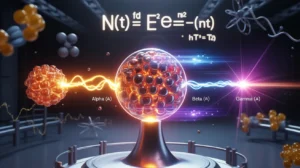
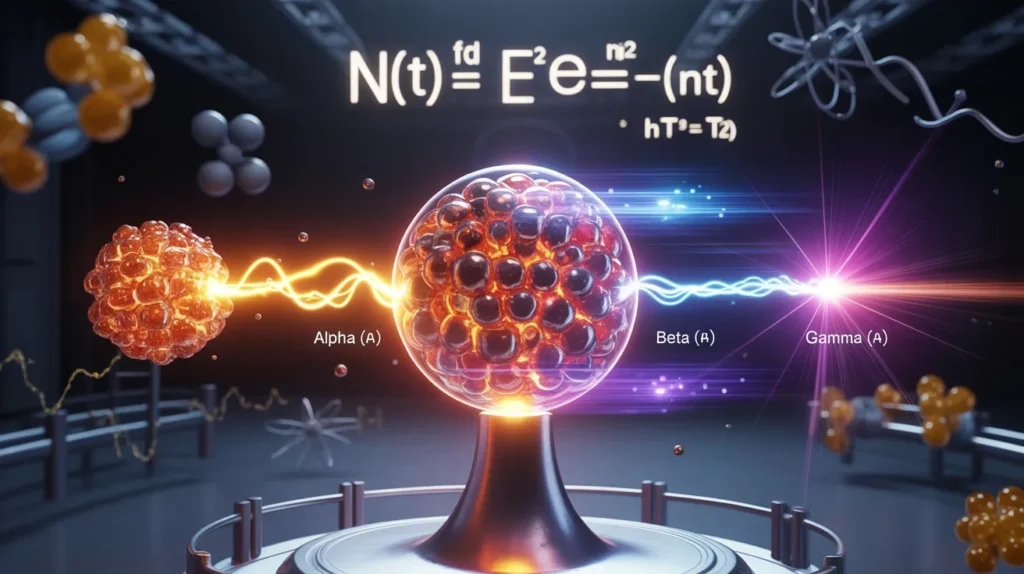
Alpha decay typically occurs in heavy nuclei (A > 200). The nucleus ejects an alpha particle—identical to a helium-4 nucleus (2 protons + 2 neutrons).
Example equation: ²³⁸₉₂U → ²³⁴₉₀Th + ⁴₂He + energy (kinetic + gamma possibly)
The daughter nucleus (thorium-234) has atomic number reduced by 2 and mass number by 4.
Why it happens: Reduces both mass and proton repulsion significantly. Alpha particles are emitted with discrete energies (4–9 MeV typically).
Key characteristics:
- Highly ionizing due to +2 charge and mass.
- Low penetration: stopped by paper, skin, or a few cm of air.
- Quantum tunneling explains the process: the alpha particle is pre-formed inside the nucleus and tunnels through the Coulomb barrier.
Real example: Uranium-238 decays via alpha emission as the start of a long decay chain ending in stable lead-206.
Expert Insight: Alpha emitters are relatively safe externally but devastating if ingested or inhaled, as all energy deposits in a tiny volume of tissue.
Beta Decay: The Weak Force in Action
Beta decay adjusts the neutron-proton ratio without changing mass number much. It is mediated by the weak nuclear force.
Beta-Minus (β⁻) Decay
A neutron converts to a proton, emitting an electron and an antineutrino: n → p + e⁻ + ν-bar
Example: ¹⁴₆C → ¹⁴₇N + e⁻ + ν-bar (carbon-14 dating classic).
Beta-Plus (β⁺) Decay / Positron Emission
A proton converts to a neutron, emitting a positron and neutrino: p → n + e⁺ + ν
This occurs in proton-rich nuclei.
Characteristics: Beta particles have a continuous energy spectrum (shared with the neutrino). Moderate penetration (meters in air, stopped by thin aluminum or plastic). Less ionizing than alpha per unit path but can penetrate skin.
Historical note: Wolfgang Pauli proposed the neutrino in 1930 to conserve energy and momentum in beta decay; it was later confirmed.
Gamma Decay: Pure Energy Release
Gamma rays are high-energy photons emitted when a nucleus drops from an excited state to a lower one, often after alpha or beta decay leaves the daughter excited.
No change in Z or A—just energy loss. Energies typically 0.1–10 MeV.
Interactions with matter: Photoelectric effect, Compton scattering, pair production. Highly penetrating; requires dense shielding like lead or concrete.
Did You Know? Gamma emission is analogous to atomic electron transitions but on a nuclear scale with vastly higher energies.
Major Differences: Alpha vs Beta vs Gamma Radiation
| Radiation Type | Particle/Energy | Charge | Ionizing Power | Penetration | Typical Shielding | Example Isotope |
|---|---|---|---|---|---|---|
| Alpha (α) | Helium nucleus | +2 | Very High | Very Low (cm air) | Paper, skin | Uranium-238, Polonium-214 |
| Beta (β) | Electron/Positron | ±1 | Medium | Moderate (m air) | Plastic, aluminum | Carbon-14, Iodine-131 |
| Gamma (γ) | High-energy photon | 0 | Low (per path) | Very High | Lead, concrete | Technetium-99m, Cobalt-60 |
Penetration and Ionization: Alpha causes dense ionization but travels little. Gamma spreads energy thinly over long paths.
Image Idea (Infographic): “Radiation Penetration Comparison” – layered diagram showing paper stopping alpha, aluminum stopping beta, lead stopping gamma. ALT: “Comparison of alpha, beta, gamma radiation penetration through materials.”
The Radioactive Decay Law: Predictable Randomness
Individual decays are random, but for large numbers N, the decay rate is proportional to N:
Activity A = λN (decays per second), where λ is the decay constant.
This leads to the exponential decay law: N(t) = N₀ e^(−λt)
Where N₀ is initial number, t is time.
Half-life (T½): Time for N to halve. T½ = ln(2) / λ ≈ 0.693 / λ
After n half-lives, fraction remaining = (1/2)^n. Activity follows the same law.
Decay constant λ: Probability per unit time of decay for one nucleus. Unique to each isotope.
Exponential Decay Explained with Examples
Think of it like a leaking bucket: the more water (nuclei), the faster it leaks initially, but the rate slows as water decreases—yet the “leakiness” (λ) stays constant.
Visual Analogy: Flip a huge number of coins every second; “heads” represents decay. Half disappear each “half-life” interval on average.
Worked Numerical Examples
Easy: Iodine-131 has T½ ≈ 8 days. Initial activity 800 MBq. After 24 days (3 half-lives)?
800 × (1/2)^3 = 100 MBq.
Advanced: Uranium-238, T½ = 4.47 billion years. Fraction remaining after 1 billion years?
λ = 0.693 / 4.47×10^9 yr⁻¹
N/N₀ = e^(−λt) ≈ 0.856 (about 85.6% remains).
Carbon-14 Example: Sample with 1/8th original C-14 activity. Age?
3 half-lives × 5730 years = 17,190 years.
Real-World Applications of Radioactive Decay
Nuclear Medicine
- Technetium-99m (6-hour half-life, gamma emitter): Used in millions of SPECT scans yearly for imaging organs.
- Iodine-131: Targets thyroid cancer with beta emissions.
Radiocarbon Dating
Living organisms maintain C-14 levels via cosmic rays producing it in the atmosphere. After death, it decays (β⁻, T½=5730 years) without replenishment. Measuring residual C-14 dates organic artifacts up to ~50,000 years.
Limitations: Calibration with tree rings and other methods needed; not for inorganic materials.
Geological Dating and Earth’s Age
Uranium-238 to lead-206 chain (T½ 4.47 billion years) dates rocks, confirming Earth’s age at ~4.54 billion years. Multiple isotope systems cross-validate.
Household and Industrial Uses
- Americium-241 in smoke detectors: Alpha ionization of air; smoke disrupts current.
- Tracers in industry for flow and wear monitoring.
- Nuclear power relies on controlled fission, but decay heat is managed post-shutdown.
Image Idea: Timeline infographic of uranium decay chain to lead. ALT: “Uranium-238 decay series showing alpha and beta steps to stable Lead-206.”
Radiation Risks, Safety, and Shielding
Ionizing radiation risks include DNA damage, cancer, or acute radiation syndrome at high doses. Safety principles: Time, Distance, Shielding (ALARA).
- Alpha: Internal hazard.
- Beta: Skin and eye hazard.
- Gamma: Whole-body hazard.
Units: Becquerel (Bq) = 1 decay/s. Curie (Ci) is larger legacy unit. Dose in sieverts accounts for biological effectiveness.
Geiger Counter: Detects ionization events for monitoring.
Common Myths and Misconceptions
- “All radiation is man-made”: Natural background (cosmic rays, radon, potassium-40) dominates for most people.
- “Half-life means the material is gone after two half-lives”: No—exponential, never fully zero.
- “Radioactive materials stay dangerous forever”: Half-lives vary; many short-lived isotopes decay quickly.
- “You can neutralize radiation with chemicals”: No—only time, shielding, or distance.
Modern Research and Future Technologies
Advances include targeted alpha therapy (TAT) for cancer, better detectors, nuclear batteries for space (using decay heat), and research into quantum effects in decay or new medical isotopes. Understanding decay chains aids in nuclear waste management and non-proliferation.
Frequently Asked Questions
What is radioactive decay?
It is the spontaneous transformation of an unstable nucleus by emitting particles or energy to reach stability.
What determines the type of decay?
The specific imbalance—too heavy (alpha), wrong N/Z ratio (beta), or excited state (gamma).
Why is decay exponential?
Fixed probability per nucleus per time leads to dN/dt = −λN, whose solution is exponential.
How does half-life work in practice?
Constant for an isotope, independent of external conditions like temperature or chemistry.
Is all radiation harmful?
In low doses, background radiation is tolerable; risk is dose-dependent. Medical uses balance benefit vs. risk.
Can you speed up or stop radioactive decay?
Generally no for natural decay processes (except some exotic cases under extreme conditions).
What’s the difference between radiation and radioactivity?
Radioactivity is the property/process; radiation is what’s emitted.
How accurate is carbon dating?
Highly accurate for appropriate samples when calibrated, with uncertainties of decades to centuries.
What happens to the emitted particles?
They lose energy through interactions, eventually stopping and becoming harmless (e.g., electrons join atoms, alphas become helium).
Are there other types of decay?
Yes, including electron capture, neutron emission, and spontaneous fission in heavy nuclei.
How is activity measured?
In becquerels; relates directly to λN.
Why do we use different isotopes for different applications?
Half-life and emission type must match the need—short for imaging, long for dating, penetrating for therapy.
Conclusion: The Enduring Legacy of Unstable Atoms
Radioactive decay reveals the dynamic, evolving nature of matter itself. From Ernest Rutherford’s pioneering work distinguishing radiation types to today’s precision nuclear medicine, it has transformed our world. Understanding alpha, beta, gamma, and half-life empowers us to harness nuclear energy safely, date our past accurately, and heal with precision.
Next time you hear about nuclear topics, remember: it’s not magic or mystery—it’s quantum physics playing out on an atomic scale, with predictable rules that have shaped our planet and continue to benefit humanity.