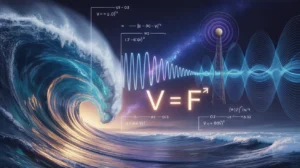
Picture yourself on a quiet beach at dawn. A series of gentle swells rolls in from the open ocean, each crest separated by a predictable distance, arriving with a steady rhythm against the sand. You don’t need instruments to sense something fundamental: there’s a pace to their arrival, a distance between peaks, and an overall march toward shore. That interplay—how fast the pattern moves, how often peaks arrive, and how far apart they sit—is the beating heart of wave physics. The equation v = fλ captures it with deceptive simplicity. Yet behind those three letters lies one of nature’s most profound organizing principles.
I’ve spent years teaching this to undergraduates wrestling with their first oscillations, graduate students modeling quantum fields, and engineers designing everything from ultrasound probes to deep-space communication. The equation never gets old because it reveals how local vibrations become traveling disturbances that carry energy across distances without hauling matter along for the ride. Let’s explore it together—not as a formula to memorize, but as a story nature tells in ripples, roars, and rays of light.
The Intuition: What v = fλ Really Means
Imagine a marching band on a football field. Each musician steps at the same frequency—say, two steps per second. If every marcher covers one meter per step, the whole formation advances at 2 m/s. That’s v = fλ in action: frequency (steps per second) times “wavelength” (distance per step, or spacing in the pattern).
For waves, the source sets the rhythm (frequency f in hertz, cycles per second). The medium—or the vacuum for light—sets how quickly the disturbance can propagate (speed v). The wavelength λ is what emerges to reconcile the two: the spatial stretch or squeeze of the pattern.
Think about this: In one second, the source completes f full oscillations. Each oscillation launches a “packet” of disturbance that spans λ meters. The front of the wave therefore advances f × λ meters in that second. Hence v = fλ. It’s not arbitrary; it’s inevitable once you accept that the wave pattern is coherent.
This relationship holds across vastly different scales: a vibrating guitar string, a dolphin’s whistle traveling through seawater, a microwave heating your coffee, or the cosmic microwave background whispering from the early universe.
Mental model: Stand beside a busy highway at night. The headlights of oncoming cars appear at a certain rate (frequency). The distance between cars feels like a wavelength. If traffic speeds up while drivers keep the same following distance, the “frequency” at which cars pass you increases. Nature balances these variables elegantly.
Diagram to visualize: A sinusoidal wave frozen in space with vertical arrows marking one full λ from crest to crest. Horizontal arrows show the pattern marching rightward at speed v. At a fixed point, the up-and-down motion occurs f times per second.
From Local Oscillation to Traveling Wave: First Principles
Waves begin with simple harmonic motion (SHM)—that graceful back-and-forth of a mass on a spring or a pendulum (for small angles). Displacement follows y = A sin(ωt + φ), where ω = 2πf is the angular frequency.
A single oscillating point disturbs its neighbors. Those neighbors, connected by elastic forces (in mechanical media) or electromagnetic fields, respond with their own delay. This chain reaction creates propagation. The time delay per distance determines speed.
Geometric meaning: Wavelength is the distance over which the phase advances by 2π radians. Wave number k = 2π/λ tells us how rapidly phase changes with position. The full traveling wave solution to the wave equation is y(x,t) = A sin(kx − ωt + φ). Plugging in shows v = ω/k = fλ. The wave equation itself (∂²y/∂t² = v² ∂²y/∂x²) emerges from Newton’s laws applied to tiny segments of the medium, revealing v as √(restoring force factor / inertia factor).
Why no net matter transport? Particles jiggle locally around equilibrium. Energy transfers through the push-pull between neighbors—potential to kinetic and back—while the overall pattern glides through.
Historical note: This understanding crystallized in the 19th century. Christiaan Huygens thought in wavefronts, Thomas Young showed interference, but it was the marriage of mathematics and experiment that made it rigorous.
Mechanical Waves: The Medium Matters
For sound, water ripples, or seismic waves, speed depends intimately on the medium’s elasticity and density.
Take a string under tension T with linear density μ. A small displacement creates a restoring force from tension components. The net result: v = √(T/μ). Higher tension stiffens the response like tighter guitar strings; more mass slows the wave like a heavy rope.
For longitudinal sound waves: v = √(B/ρ), where B is the bulk modulus (resistance to compression) and ρ is density. Air at 20°C: ~343 m/s. Water: ~1480 m/s. Steel: around 5000–6000 m/s. Molecules in solids are tightly bound, passing compressions almost instantly.
Table: Approximate Wave Speeds
- Sound in air (20°C): 343 m/s
- Sound in water (20°C): 1,480 m/s
- Sound in steel: ~5,120–5,900 m/s
- Light in vacuum: 299,792,458 m/s
- Light in glass (typical): ~200,000,000 m/s (refractive index ~1.5)
Graph idea: Logarithmic bar chart showing mechanical waves varying wildly while electromagnetic waves sit at c in vacuum.
Electromagnetic Waves: Dancing Fields in the Void
James Clerk Maxwell’s equations unified electricity and magnetism and predicted waves propagating at c = 1/√(μ₀ε₀) ≈ 3 × 10⁸ m/s—exactly the measured speed of light. Hertz later generated and detected radio waves, confirming Maxwell’s vision. Light is an electromagnetic wave.
Why vacuum? Changing electric fields create magnetic fields (and vice versa) even in empty space. No medium required—the fields sustain each other. This self-propagating transverse dance explains polarization, too.
In media, atoms respond to the oscillating E-field, slowing the average propagation (phase velocity) while frequency stays the same. Hence wavelength shortens: λ_medium = λ_vacuum / n.
Advanced insight: Phase velocity vs. group velocity. Phase velocity is the speed of a single frequency’s crests (v_p = ω/k). Group velocity (v_g = dω/dk) carries energy and information. In vacuum they match; in dispersive media they differ, sometimes dramatically. Anomalous dispersion even allows v_g > c or negative—without violating relativity, as no information travels faster than c.
The Electromagnetic Spectrum: One Phenomenon, Many Faces
All electromagnetic waves obey c = fλ in vacuum, yet their interactions with matter differ profoundly because photon energy E = hf scales with frequency (h = Planck’s constant).
Detailed Electromagnetic Spectrum Table (approximate ranges):
- Radio waves: λ > 1 m, f < 300 MHz, E < ~10⁻⁶ eV — broadcasting, radar, astronomy.
- Microwaves: λ 1 mm–1 m, f 300 MHz–300 GHz — ovens, 5G, cosmic background.
- Infrared: λ 700 nm–1 mm — thermal radiation, night vision, fiber optics.
- Visible: λ 400–700 nm, f ~4–7.5 × 10¹⁴ Hz — our evolutionary window.
- Ultraviolet: λ 10–400 nm — ionization, sterilization.
- X-rays: λ 0.01–10 nm — penetrate soft tissue.
- Gamma rays: λ < 0.01 nm, f > 10¹⁹ Hz — nuclear processes, astrophysics.
Infographic description: Logarithmic wheel or bar spanning from kilometers to attometers, with icons for applications and a side energy scale in eV.
Quantum Connection: From Classical Waves to Photons and de Broglie
Planck introduced quantization to explain blackbody radiation. Einstein’s photons (E = hf) explained the photoelectric effect. de Broglie extended the wave idea to matter: λ = h/p. Waves and particles are two sides of reality.
Fourier analysis decomposes complex signals into frequency components—crucial for MRI (spatial encoding via magnetic gradients and radio waves), signal processing, and understanding wave packets (localized disturbances with a spread of frequencies, leading to dispersion).
Wave packets visualization: Animation of multiple sine waves superposing to form a localized pulse that spreads in dispersive media.
Doppler Effect and Cosmology
When source and observer move relative to the medium (sound) or each other (light), frequency shifts. Racing car pitch drops as it passes. For light, relativistic Doppler formula and cosmological redshift reveal an expanding universe—galaxies racing apart, stretching wavelengths.
Diagram: Compressed wavefronts in front of a moving source.
Standing Waves, Resonance, and Everyday Magic
Fixed boundaries create interference patterns with nodes and antinodes. Guitars, vocal tracts, bridges, even buildings at certain wind frequencies. Resonance amplifies when driving frequency matches natural frequency—beautiful in music, catastrophic in engineering (Tacoma Narrows).
Refraction, Dispersion, Diffraction, Interference
Speed change bends rays (Snell’s law). Dispersion separates colors in prisms because n varies with frequency. Huygens’ principle explains diffraction around obstacles—why you hear around corners but light casts sharp shadows (mostly).
Fiber optics: Total internal reflection traps light, enabling global communication with minimal loss.
Modern Applications: From Medicine to the Cosmos
- Ultrasound: High-frequency sound for imaging fetuses or tumors.
- MRI: Radio-frequency pulses in magnetic fields exploit nuclear spin resonance.
- Radar/Sonar: Echo timing and Doppler for velocity.
- Lasers: Coherent light for surgery, cutting, communications.
- Gravitational waves: Ripples in spacetime detected by LIGO—another wave phenomenon at cosmic scales.
- Wireless tech: Antennas sized to fractions of wavelength for efficient radiation.
Table: Wave Applications Comparison
- Medical: Ultrasound (mech), MRI (radio), X-ray (EM).
- Communication: Radio/microwave, fiber (IR/visible).
- Exploration: Seismic, radar, telescopes across spectrum.
Common Misconceptions
- “Waves move at the speed of their particles.” No—particles oscillate; pattern propagates.
- “Light needs a medium.” The luminiferous ether was disproven.
- “Higher frequency always means higher speed.” Usually not; v is fixed in non-dispersive media.
- “All waves transfer matter.” Energy and information, yes; net matter, no.
Expert-Level Insights and Thought Experiments
Imagine a wave packet approaching a barrier. Quantum tunneling emerges naturally from wave behavior. Or consider: if frequency changed at media boundaries, phase continuity at the interface would break—hence f is conserved while λ and v adjust.
de Broglie thought experiment: Electrons showing diffraction patterns in crystal lattices—matter waves confirmed.
Frequently Asked Questions
Why does frequency usually not change when a wave crosses media boundaries?
At the interface, the wave must remain continuous—displacement or field values can’t jump discontinuously. This boundary condition forces the transmitted and reflected waves to oscillate at the same frequency as the incident wave. Wavelength and speed adjust (λ = v/f), but the rhythm stays locked. This is why a violin note keeps its pitch when entering water, though its wavelength changes. Deeply important for spectroscopy and all wave-matching phenomena.
Why does light slow down in glass, and what’s really happening?
The electric field of the light wave drives electrons in glass atoms to oscillate. These oscillating charges re-radiate secondary waves that interfere with the original. The net result is a phase delay, reducing the effective propagation speed. Individual photons still travel at c between interactions, but the collective wave is delayed. No violation of relativity—the information-carrying front still respects c.
What is the difference between phase velocity and group velocity?
Phase velocity is how fast individual crests move (v_p = fλ = ω/k). Group velocity is how fast the overall envelope or energy packet travels (v_g = dω/dk). In vacuum, they’re equal. In dispersive media like glass or plasma, they differ. For normal dispersion, v_g < v_p. This distinction matters enormously in pulse transmission—fiber optics engineers design around it to minimize broadening.
Can waves travel faster than light?
Phase velocity can exceed c in certain dispersive cases (e.g., X-ray region in some materials), but group velocity and signal velocity do not. Relativity remains intact—no usable information or energy travels superluminally. Gravitational waves also propagate at c.
Why do low-frequency waves often travel farther?
Lower frequencies interact less with small obstacles (diffraction is stronger), suffer less absorption in many media, and have lower photon energy (less likely to excite atomic transitions). Radio waves wrap around the Earth; high-frequency gamma rays are stopped quickly.
How do radio antennas relate to wavelength?
Efficient radiation or reception occurs when antenna dimensions are resonant with the wavelength—often λ/4 or λ/2 for dipoles. This creates standing waves of current, efficiently coupling electrical energy to electromagnetic waves.
Why are gamma rays dangerous while radio waves are not?
Photon energy E = hf. Gamma photons carry MeV energies capable of breaking DNA bonds and ionizing atoms. Radio photons have tiny energies (~10⁻⁶ eV), insufficient even to excite molecular vibrations significantly. Danger scales with frequency across the spectrum.
How does Doppler shift prove the universe is expanding?
Distant galaxies show redshifted spectra—absorption lines shifted to longer wavelengths. This cosmological redshift indicates recession velocity proportional to distance (Hubble’s law), revealing expansion. It’s not motion through space but stretching of space itself.
Why do musical instruments rely on standing waves?
Fixed ends (or open/closed pipes) create boundary conditions producing discrete resonant frequencies. The instrument selects harmonics from the broad excitation spectrum, giving each its characteristic timbre via Fourier components.
What causes resonance catastrophes?
When driving frequency matches a structure’s natural frequency and damping is low, amplitude grows dramatically. Energy input per cycle exceeds dissipation. Tacoma Narrows Bridge (1940) is the classic warning—wind created vortex shedding at the bridge’s resonant frequency.
How do fiber optics use total internal reflection?
Light traveling in high-index core hits the cladding (lower index) at angle > critical angle. Snell’s law predicts no transmitted ray—100% reflection. Pulses of light (modulated data) travel vast distances with minimal loss, enabling global internet.
Why is wavelength inversely proportional to frequency?
For fixed v, λ = v/f. Higher frequency means more cycles packed into the same propagation distance per second. Geometrically, the spatial period shrinks. This inverse relationship appears everywhere—from de Broglie matter waves to electromagnetic spectrum.
How does wave interference create noise-canceling headphones?
Microphones sample ambient sound. Electronics generate an “anti-phase” wave (180° shift). Superposition yields destructive interference—ideally zero net pressure variation at your ear for the unwanted frequencies. Active noise cancellation at work.
Why is the speed of light fundamental in relativity?
Maxwell’s equations predict c independent of source motion. Einstein elevated this to a postulate: laws of physics (including c) are the same in all inertial frames. This leads to time dilation, length contraction, and E=mc². c is the cosmic speed limit and conversion factor between space and time.
What is the deep connection between waves and quantum mechanics?
Everything exhibits wave-particle duality. Schrödinger’s equation is a wave equation for probability amplitudes. Interference, diffraction, and tunneling are wave phenomena. Even macroscopic objects have de Broglie wavelengths, though tiny. Quantum field theory treats particles as excitations of underlying fields—ultimate wave mechanics.
(And several more could expand on Fourier, standing waves in quantum wells, etc.)
Key Takeaways
- v = fλ is universal yet flexible—v often set by medium, f by source, λ the negotiator.
- Waves transfer energy and information via local oscillations.
- Mechanical waves need media; electromagnetic waves create their own.
- Frequency links classical waves to quantum energy (E = hf).
- Understanding these principles unlocks technologies shaping our world and reveals cosmic structure.
Conclusion
The equation v = fλ is more than a tool—it’s a window into how the universe organizes disturbance and transmission. From the first oscillating atom after the Big Bang to the gravitational waves rippling from merging black holes, waves carry the story of reality. Mastering them doesn’t just help you pass exams or design better gadgets; it changes how you experience the world. Next time you watch ocean waves, listen to music, or use your phone, remember: you’re witnessing one of nature’s deepest patterns playing out in plain sight.
The rhythm continues. The crests keep coming. And physics keeps revealing why.